Showing posts with label John Dominic Crossan. Show all posts

Tuesday, August 2, 2011

Jesus: Proclaimer of the Now and Future Kingdom

When I first created this blog my purpose was to discuss politics. But it appears that religion has come to dominate more and more of my posts. Things change of course and I will, no doubt, return to politics as a primary focus eventually. For now, however, I shall continue to post on the matters most in my thoughts, and presently those matters pertain to religion.

I want to write briefly about the central message of the Historical Jesus.* But first some necessary preliminaries:

1) By the term "Historical Jesus" I refer to the actual flesh and blood person who walked the dusty roads of ancient Israel, insofar as that individual can be reconstructed by means of historical-critical scholarship. This Jesus is not to be confused with the "Jesus of Faith." The latter is Jesus as he is experienced in the religious life of Christian believers. The difference between these two is crucial to solid scholarship.

2) The four New Testament gospels are not straightforward historical accounts. This is a fact that no serious Bible scholar or historian doubts and it has been well known for around 200 years now. The gospels contain myths and legends (e.g. the birth stories, the temptation by the devil, walking on the sea) exaggeration, theological musings projected into narratives about Jesus, propaganda, and so forth.

3) Despite (2) the gospels are not useless as historical documents. Two centuries of painstaking historical research has established beyond reasonable doubt that the synoptic gospels (Matthew, Mark, and Luke) have a solid historical foundation. The gospel of John is not close to history and is not accorded the same status as the synoptics by historians.

4) The narrative spine of Mark (and thus Matthew and Luke who used Mark as a primary source) is broadly historical: Jesus came from Nazareth, briefly followed and was baptized by John the Baptist, shortly after John's arrest went out on his own mission, chose disciples to follow him and do what he was doing, taught in parables, gathered people together around a common meal, worked as an itinerant healer and exorcist, and, at Passover in the year 30, journeyed to Jerusalem, confronted the leaders there with the judgment of God by word and deed (the demonstration in the temple) and was crucified by Rome for his troubles.

5) Scholars also generally agree that much of the teaching in a hypothetical document called "Q" is authentic to the Jesus of history. Q is a source that was used by Matthew and Luke (they also used Mark). We have no copy of this source as it is lost. But it is clearly visible in the passages that Matthew and Luke have in common but that are not in their other source, Mark. It is also fairly clear that the majority of the parables (though not the interpretive gloss gospel writers sometimes give them) go back to the Jesus of history as well.

6) But, even in "Q" and Mark we do not have unbiased plain history. And scholars are careful to point out that in those two early sources some material is still suspect. In particular, passages that too obviously reflect the theology of the later Jesus movement (as evidenced in, say, Paul's letters) is unlikely to go back to Jesus. Passages in which Jesus speaks to the conditions of his followers in the 50s and 60s (see Mark 13) are clearly not from the Jesus of history, nor are passages in which Jesus speaks of himself as a heavenly judge and one who will come again - this rules out all future "son of man" passages, which has very important ramifications, as will be seen below.

With these preliminaries in place we can now ask who Jesus was? Or better, what picture of Jesus emerges from our earliest sources (Q and Mark - excluding the obviously unhistorical passages)?

I will here restrict myself to the core image in the teaching of the historical Jesus: The Kingdom of God. Better translated as the "ruling activity of God" this phrase refers to the concrete activity of God in the world whereby He establishes that He is in charge. The phrase does not indicate a place or nation in which God is actually the king.

Though the phrase "Kingdom of God" could mean many things, by the time of Jesus it serves as an eschatological image. Eschatology is that branch of theology dealing with "end-times," death, judgement, eternal life, Heaven and Hell. But used in reference to the period in which Jesus lived it refers rather to the expectation and hope, shared by many of the Jewish people at the time, that God would soon act decisively in human history to once and for all end injustice, oppression, and evil and usher in an age of prosperity, peace, and harmony.

Some scholars misleadingly speak of the time that God would do this as "the end of the world." But that is not what most of these Jewish people expected (Crossan The Greatest Prayer, 79). What they expected, rather, was that God would transform this world, not end it. Many did expect that only a supernatural act could accomplish this and thought also that events like the raising of the righteous dead to new life would accompany the eschaton. Indeed, most early Christians thought that the kingdom would be decidedly established by a return of Jesus to earth, to end evil and usher in an age of everlasting peace.

Many scholars have claimed that Jesus' own eschatology was close to that of the early Christians. He too, so they argue, expected a supernatural event in the very near future that would transform the world forever. On this view, Jesus' message was simply "the kingdom is coming soon, so you better repent and get ready for it."

I don't think this position is particularly well supported for several reasons. First the only gospel passages in which Jesus speaks of an imminent and spectacular arrival of God's kingdom are in the passages in which he speaks of the coming of the son of man (himself) from heaven. But the work of such scholars as Geza Vermes and Norman Perrin (as well as many others) demonstrate clearly that such passages do not go back to the historical Jesus, but are products of the early Jesus movement and depend upon the belief that the executed Jesus is raised up to God's right hand and that he will return from there to establish everlasting justice and peace. These passages reflect the view of Jesus' followers after his death, not the view of Jesus himself.

Second, Jesus' message in Q and Mark is simply not "repent, pray and wait for God to act." On the contrary his message reads more like "This is what the kingdom is, you are called to live out and participate in that kingdom, so get to work!" (Crossan The Greatest Prayer, 90)

So the overtly apocalyptic or end-of-the-world Jesus is not the Jesus of history. Nevertheless, I cannot quite agree with those scholars who claim that for Jesus the Kingdom of God is only a present reality made known to those who realize it in themselves. Even without the son of man passages there are enough texts that show that Jesus did teach that the kingdom, though clearly a present reality to enter now, in its full glory lies in the future (Matthew 5: 3-11, Mark 14: 25, etc.).

Did Jesus then believe that the great eschaton was soon to come? That God would indeed radically act so as to transform the world forever?

It seems to me that a careful reading of the earliest sources does not support the claim that Jesus spoke of a Kingdom of God about to burst upon the world in the future, either immediately or at some unspecified time. Nor do those teachings support that Jesus denied this in favor of a mystical present kingdom. Geza Vermes has expressed the position I am reaching for well:
[Q]ueries concerned with whether the kingdom had come, was on the way, or would come later, must be irrelevant. At issue in New Testament eschatology is the actual movement itself of turning back, of entering into the kingdom. It is in the surrender of the self to God's will that his sovereignty is realized on earth (Jesus in his Jewish Context, 35).
And Norman Perrin expressed it similarly:
In the teaching of Jesus the emphasis is not upon a future for which men must prepare, even with the help of God; the emphasis is upon a present which carries with it the guarantee of the future (Rediscovering the Teaching of Jesus, 205).
In short if we are to understand the eschatological mindset of the historical Jesus we must look to what he actually says about the kingdom. Jesus speaks of the kingdom as a reality that people can enter now (Luke 16.16), that is among us (Luke 17:20), but that will be our destiny in the future as well (Mathew 8:11). The kingdom is known in acts of healing (Luke 11:20) in the embracing of social outcasts, forgiving each other, in peace, non-violence, love for others, and the fight for justice (Matthew 5-7). In short, it is in healing each other, forgiving each other, battling injustice, and ending oppression that the kingdom is entered into by all who choose it here and now.

For Jesus, it appears, the full fruits of the kingdom do lie in the future, but it does not seem that his message is about waiting for that future. Rather than seeing the kingdom as imminent - as about to burst forth on the earth - it seems that Jesus saw the kingdom as ultimate. The Hebrew God of justice and compassion would, in the end, perfect the world, would eliminate injustice and usher in a time of everlasting peace and plenty for all. This is the heart of prophetic Judaism, and the core of the vision of the historical Jesus. Where Jesus takes his faith in God's kingdom a step further is in his clear conviction that the coming kingdom is even now already present. Like the leaven in the dough that has not yet risen, or the mustard seed that has not yet grown into a great tree, the kingdom is here, now and we may enter it, confident that the tree will grow and the bread will rise, and we must work with it.

So the message is not to wait for God to fix things. The message of the historical Jesus is rather, embrace the outcasts, combat injustice, forgive those who have wronged you, heal the sick. Do all this and you have entered the kingdom. As John Dominic Crossan puts it:
[Jesus called others] to do exactly what he himself was doing: heal the sick, eat with the healed, and demonstrate the kingdom's presence in that reciprocity and mutuality. It is not, he said, about intervention by God, but about participation with God. God's Great Cleanup of the World does not begin, cannot continue, and will not conclude without our divinely empowered participation and transcendentally driven collaboration (The Greatest Prayer, 90).
*My understanding of the Historical Jesus is most indebted to the work of John Dominic Crossan and Marcus Borg. But I also draw considerably on Geza Vermes and Norman Perrin. To a lesser but non-trivial extent I am indebted to the work of N. T. Wright and Richard Horsley. I find the Jesus of such scholars as Paula Frederickson, Ed Sanders, and Bart Erhman to be historically problematic (given its rejection of politics and its reliance on "the son of man" style eschatology), and the very non-jewish wondering sage (who seems to have no relation to Jewish politics or eschatology!) of Robert Funk and Burton Mack even more so.

Note: The Picture accompanying this post is from a BBC documentary which attempts to construct a face for Jesus that actually looks like a 1st century Galilean.

Bookmark and Share

Sunday, September 19, 2010

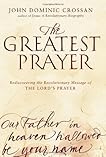
Crossan's Revolutionary Prayer Book

The Greatest Prayer: Jesus's Revolutionary ManifestoThe Greatest Prayer: Jesus's Revolutionary Manifesto by John Dominic Crossan

John Dominic Crossan's newest book - besides offering tremendous literally criticism and poetic insight - provides much needed depth into a subject matter that those who ascribe to liberal theology sometimes struggle with.

Accustomed as we are to a Christian tradition that all too often reduces prayer to "asking God for things," but at the same time philosophically unable to think of God as a person-like being, we simply don't know what do to with prayer; or as Paul of Tarsus (quoted approvingly and used at length by Crossan) puts it "We do not know how to pray as we ought" (Rom. 8:26).

Crossan shares a rejection of any crude anthropomorphic understanding of prayer, "it is an immature view of prayer that addresses a Supreme Being radically apart from us who thinks, and wills, knows and hears, grants and refuses more or less as we do, but with infinite broadband" (28).

Noting that the Prophets of ancient Israel seem to reject prayer and insist that God requires distributive justice (care for widows, aliens, and orphans) instead of prayer and ceremony, Crossan nonetheless does not think we are faced with some either/or. For him, prayer and justice are distinguishable but inseparable. Like two sides of a coin, we cannot have prayer without justice or justice without prayer (20-21).

From this starting point, Crossan turns to the most well known prayer in the Christian tradition, variously called the "Our Father," or the "The Lord's Prayer." This prayer, Crossan argues, expresses the heart of the message of Jesus. The prayer asks us to come together as equals, to become heirs of God, and to work together to establish the divine reign here on earth. We do this by sharing with each other fairly and equally.

Crossan spends much of the book describing the vision of an egalitarian justice found throughout the pages of the Bible. Most striking is his thouhtful examination of the use of the Sabbath tradition. Crosssan argues, persuasively, that the Sabbath is the crown of creation in Genesis Chapter one, and that the later traditions of the weekly Sabbath, Sabbath year (every Seventh year), and year of Jubilee (a kind of super Sabbath every fiftieth year), is designed to recall and enact a world of unity, non-violence, equality, and peace. His discussion of the Sabbath is among the finest I have read.

Prayer, Crossan argues, is meditation on the divine vision of a just, fair, peaceful, and non-violent world. The message of Jesus is a message that we can and must work together with God to bring about such a world. When we pray, then, "The Lord's Prayer," we remind ourselves that God and God's kingdom are present only when share our resources, forgive others their debts, and work together for peace, and that God's kingdom will only be fully present when ALL have enough, when ALL debts are forgiven and when ALL people are free to live together and live peacefully.

The book builds on Crossan's earlier work, especially God and Empire, and most of the themes are found throughout his writings. Yet there is a freshness to the presentation here, an application that warrants attention. Although most of the themes are not new for Crossan, how those ideas effect our prayers, and particularly how we say "The Lord's Prayer" is a novel application of them.

If you are open to non-traditional Christian theology and a faith informed by reason and historical method, this is the prayer book for you.

Bookmark and Share

Sunday, March 28, 2010

Palm Sunday: A Passion for Peace through Justice


Today is Palm Sunday, the beginning of Holy Week for Christians. On Palm Sunday Jesus enters Jerusalem riding a donkey, hailed by followers waving palm branches. The action is a deliberate symbolic protest.

Biblical Scholar John Dominic Crossan pinned an article just two days ago which explains exactly what Jesus was up to:
Jesus went up to Jerusalem to make twin demonstrations, first against Roman imperial control over the City of Peace and, second, against Roman imperial control over the Temple of God. In other words, put personally, against the (sub)governor Pilate and his high-priest Caiaphas.
Together with his friend and colleague Marcus Borg, Crossan wrote an excellent book a few years back with elaborates and clarifies Jesus purpose in Jerusalem: The Last Week. Early in this book they explain that:
The Meaning of the demonstration is clear, for it uses symbolism from the prophet Zechariah in the Jewish Bible. According to Zechariah, a king would be coming to Jerusalem (Zion) "humble, and riding on a colt, the foal of a donkey" (9:9).... The rest of the Zechariah passage details what kind of king he will be .... This king, riding on a donkey, will banish war from the land - no more chariots, war-horses, or bows. Commanding peace to the nations, he will be king of peace.

Jesus' procession deliberately countered what was happening on the other side of the city [that Sunday, Pilate entered the city in a pompous pro-empire procession]. Pilate's procession embodied the power, glory, and violence of the empire that ruled the world. Jesus' procession embodied an alternative vision, the kingdom of God.
The kingdom of God is the heart of Jesus' life and message. Dedicated to non-violence, inclusiveness, justice for the poor and afflicted, and peace through justice for all, Jesus entered Jerusalem intentionally opposing his message and his mission to the power and injustice of empire.

The problem with Rome and the Priesthood for working so closely with Roman power. Was that this power disenfranchised, exploited, and oppressed the peasantry (a good 90% or so of the population) simply to create wealth and power for the elites.

Or to quote from Crossan once more:
After centuries of subjugation to various empires, the Jews of Jesus' time wanted to know: if God is just, and the world belongs to God, why is the world so unjust? One stream of Jewish tradition answered that question with this mantra: God will overcome, someday. At some point in the future, God would not only clean up the mess but also create a perfect world.... 
[To fight against Roman imperial power] Jesus told his companions to heal the sick, to eat with those they healed, and to announce that the Kingdom of God had arrived. Healing is the basic spiritual power. Eating is the basic physical power. That mutual sharing of spiritual and physical power, in a sense, recreated the sharing aspects of peasant life in contrast to the greedy life under Antipas' Romanization process. 
Think about those twin aspects for a moment. Those who bring healing and those who furnish eating are not exactly in the same position. They represent, respectively, itinerants and householders. By itinerants, I mean people pushed off family farms or family boats as the New World Order arrived in Lower Galilee. 
Think, for example, of how readily fishermen followed Jesus. By householders, I mean families who know how easily they could lose their own farms or boats in a changing economy. As itinerants and householders faced one another, the former saw where they had been, and the latter saw where they could be. The program of the Kingdom was to join both groups in support and common life.

In Leviticus 25:23 God says that, "The land shall not be sold in perpetuity, for the land is mine; with me you are but aliens and tenants." Land is life itself and cannot be bought and sold like other commercial commodities. In the gospels and throughout the New Testament there is little said about land and much said about food. But the continuity is clear--land is there for food, and the basis of life is land because it produces food.

Jesus' Kingdom program was not just about politics or economics as distinct from theology. It combined religion, politics, and economics; it was about divine distributive justice; it was about the ownership of this world; it was about a theology of creation ("Jesus' Kingdom Program" Belief-net).
In other words, Jesus challenged his hearers to disobey Roman power by living in God's kingdom here and now. In effect he claimed that Roman authority was null and void, that the Temple leadership was dissolved, and that God was ruling in our midst. No wonder the authorities killed him!

To follow Jesus, therefore, is to oppose the forces of empire and violence. To fight for the radical inclusion and healing of all people.

Palm Sunday offers us a choice: we can follow Jesus the messiah of peace and justice, or align ourselves with the forces of empire. THAT is the gospel; THAT is the passion of Holy Week.
UPDATED: APRIL 1, 2012


Bookmark and Share

Wednesday, May 6, 2009

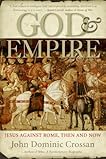
God and Empire


God and Empire: Jesus Against Rome, Then and Now God and Empire: Jesus Against Rome, Then and Now by John Dominic Crossan


This is one of Crossan's finest works. The basic premise is that the Kingdom of God as understood by Jesus and the "Lordship of Christ" as taught by Paul are anti-imperial - not just anti-Rome, which of course they are, but opposed to what Crossan aptly calls "the normalcy of Civilization."

Crossan argues, quite compellingly, that the normalcy of civilization is both a hierarchy which privileges some and oppresses and exploits others, and is also committed to violence - the claim that peace can only be achieved by violent conquest of one's enemies and violent punishment of those who upset the established order. Anyone who knows anything about human history will see that Crossan is clearly correct that this is indeed the normal way human civilization operates.

The alternative vision of Jesus and Paul negates the normal ways of civilization. Jesus and Paul preach an egalitarian vision in which all stand equal before God and are called to share equally in each other's resources. Furthermore, Jesus and Paul eschew violence in favor of a non-violent (but nonetheless fiercely resistant) approach to living and being. (Simply read Matthew 5-7, Acts 4:32-35, and Galatians 3:28 and you will quickly see that Crossan has solid textual support for his position).

In short, for Jesus, and Paul after him, God is known to us in a life of non-violence and distributive justice. They offer us a world where all share God's resources equally and live together peacefully. And they offer this world as the divine counter vision of "the normalcy of civilization."

Near the end of the book Crossan contrasts the non-violent Jesus who walked the earth with the fantasy of violent retribution found in the Jesus of Revelation and much current theology. We cannot have both, we must choose either a violent or non-violent Jesus. The former is the Jesus of apocalyptic vengeance, the later the Jesus of history. The two are not compatible.

The choice is important, Crossan argues, not merely because only non-violence and egalitarianism can save the human race, but also because the choice determines how we see God. Is God a patriarchal and violent deity? Or a non-violent and egalitarian deity? How we see God is crucial, for we act out what we think God is like.

A fine read and a must read for anyone who, as we all should be, is worried about the rise of "violent religion" in much of the world today.

Here is a nice summary of one of the main themes by Crossan himself:


Bookmark and Share