I really wish I would have thought of something this clever and telling! But alas, I discovered it only recently. Well reading an article on Social Darwinist Romney VP pick Paul Ryan at Mother Jones Magazine, I learned of GOP Je$us. The basic premise of this clever satire is this: what if Jesus were - instead of a non-violent, anti-greed, inclusive preacher - actually like the right wing of the GOP who claim they follow him. I give you, the GOP Je$us and his Tea-Party Gospel, via his Facebook page:
The Me-Attitudes
Blessed are the rich, the reign of this world is ours
. The rich rule the world, and the rest suffer and die, often in misery. Do not let this be you my brothers! Easier to use your riches to genetically engineer very small camels that can fit through the needle's eye…
Blessed are the violent and the invincible, the proud and the powerful, the domineering and oppressive
. We can have it all! And let our status of power be the proof that we are deserving of the fruits of the labor of the middle class and poor…
Blessed are those who show no mercy.
No mercy to the poor, to women and children, the elderly and the homeless, victims, outcasts, enemies, refugees, the hungry, the undocumented, the unborn, those on death row, those who are different, those we don’t like. And of course, those who happen to be in the way of what we want…
Blessed are the warmakers.
Yea I say unto you, if we were not making war, we could not be said to be making much. That is what China is for! Lo, the Lord looked at China and said "Let it be the worlds factory floor," and it was good…
Compare the Me-attitudes of GOP Je$us to the Beatitudes of Jesus of Nazareth, then take a look at the real Jesus' teachings about wealth. The stark contrast between Jesus and the GOP Je$us satire is well done. This brings the heart of the matter home powerfully. One cannot follow the economic philosophy of the right wing and at the same time follow Jesus. The two are irreconcilable and fundamentally opposed.
There are two primary types of arguments offered to support the Right-Wing agenda of deregulation, cuts to social welfare programs, and tax cuts for the wealthy. The first type of argument is consequentialist. Advocates of this approach claim that cutting taxes on the wealthy, deregulating markets, and slashing social welfare programs are better for everyone. These moves will, they argue, make us all wealthier.
This is line of argument is absolutely false. The empirical data is unequivocal: the Right-Wing economic agenda benefits the very wealthy only. Wealth never trickles down, deregulation never helps main street, cuts to social welfare programs never help the unemployed and working poor. These policies have been implemented since the late 1970s, and all that has happened is that poverty has increased, middle class and working people have seen no rise in income, but have lost their pensions, their health insurance, and become buried in debt. Fewer and fewer people can own a home, send their kids to college, or pay their medical bills.
The consequentialist arguments are demonstrably, empirically, and indubitably wrong.
The second kind of argument is a moral one. The following video clip of Fox News' Stuart Varney provides a good example:
According to Varney and those who think like him, it is immoral to take more from the rich. They are entitled to what they have earned, and they are better off than the rest of us because they "worked harder" and "made themselves."
There are several problems with this type of argument:
1) The wealthy have not, as a class, worked harder than anyone else. That's just plain false. Working class people often work themselves to exhaustion and even death, and wealthy people sometimes can go years without breaking a sweat. No economic class, as a group, is divided from others on the basis of how hard they have worked.
2) There are no self-made individuals. In point of fact, there is a great deal of empirical evidence that persuasively demonstrates that, in nearly every case, the very wealthy have become so with the help of (a) being born and raised with wealth and privilege and (b) the assistance of government services and subsidies - usually more so than the rest of us. Or, as Elizabeth Warren nicely sums up in the following video:
Finally, 3), as John Rawls persuasively argues, to claim that one morally deserves X one must demonstrate that one has earned X chiefly through one's own moral or individual efforts. But this is simply not possible in the case of wealth. How much personal wealth one accrues depends on a number of arbitrary factors. First, and most importantly, wealth is often a mere accident of birth, some of us are born more or less fortunate than others. Second, often our income level is determined by our natural talents. But, although we can develop these, we cannot create them. If I do not have a talent that can earn me a great deal of money, then I will not earn a great deal of money. Third, which talents pay best is based on the arbitrary preferences of society. In our society talk show hosts and professional athletes make millions, whereas school teachers make, on average, 43,000 a year. Does a talk show host, say Oprah Winfrey, deserve to be extremely wealthy in some moral sense that a teacher does not? Hardly. The difference between her wealth and theirs depends on the arbitrary whim of society. It is, therefore, not reasonable to claim that the wealthy are morally wronged if they are taxed at higher rates than those who earn less.
The moral arguments for the Right-Wing agenda fail, just as the consequentialist arguments did.
Now turning from the Right-Wing agenda to the Progressive one, can a good case be made for the Progressive agenda of high taxes on the wealthy, strong social safety nets, and powerful government spending on the public good? Yes they can.
On consequentialist grounds the Progressive agenda is clearly a good idea. Imagine the reduction in crime if far fewer Americans lived in poverty, were well-educated, had good jobs, nice retirement plans, and access to affordable quality health care! Imagine how much better the United States would compete in the world if our schools were properly funded - not to mention the moral satisfaction in being sure that our society provides for those who are suffering, who are down and out.
Furthermore, the most prosperous time in our nation's history was the period after WWII into the mid to late 70s. During that time our income inequality was at it's lowest, unions were at their strongest, regulations at their most intense, and taxes on the wealthiest 1% of income earners was never below 70%. Coincidence? If so, then explain the fact that this boom did not exist before these policies, and failed to exist afterward. Explain the occurrence of the same trends in Europe.
More importantly, however, is the moral case for a strong welfare state. As a society we need food stamps and unemployment insurance for those who are poor, health care for all, good public schools, good public roads, parks, libraries, and community centers. We need all of these because our society is a healthier, happier, safer, and much better place when we have them in all their strength. Even those who are wealthy enough to get by with their private schools, gated communities, and personal Islands, are safer and more secure in a society where those around them benefit from good social services and programs.
Consider an analogy: Vaccines prevent deadly diseases. Not everyone, however, can be vaccinated for every disease. The elderly, the very young, some people with chronic illness or disabilities, cannot take certain vaccines. In a population where the vast majority of people are vaccinated, this is not a problem. Those who cannot be vaccinated are protected by what is known as herd immunity. Because so many people are vaccinated, the feared disease cannot enter the population and the unvaccinated persons are safe. Having myself or my child vaccinated, in other words, is not merely of benefit to me and my child, but is a public good, from which we all benefit. A community without measles or polio is much better off than a community with these dangers.
Unfortunately an increasing number of parents refuse to vaccinate their children. These parents fear that vaccines are dangerous and may even cause autism. Science has conclusively refuted these fears. Many parents, however, refuse to believe the scientific community and don't vaccinate any way. The result is that diseases like whooping cough and measles have returned. The unvaccinated have suffered because of this, often even dying as a result.
The Right-Wing agenda for economics is as irrational and as dangerous as parents who won't vaccinate their children. Because an increasing number of Americans have come to believe over the last 35 years or so - in spite of the empirical facts! - that the wealthy both morally deserve all their wealth and will benefit the rest of us by keeping it (and getting more), we have seen our social welfare programs slashed, our public services eviscerated, our social contract torn to shreds.
The result is a less educated, less secure, less healthy, more impoverished, and increasingly divided society. This is a recipe for total disaster that can, in the end, finish only with widespread rebellion, despair, and disaster.
We must now either wake up to the failure of the Right-Wing economic agenda, or watch things get much worse.
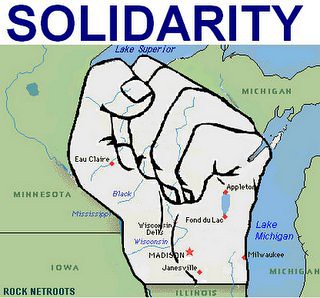
As the conflict in Wisconsin over Gov. Walker's proposal to strip unions of their right to collective bargaining continues, I find that many still do not understand what the debate is all about and why Walker's actions are terribly wrong and even deeply immoral.
First, let us dispel a few red herrings. This debate is not about whether unions have their flaws and foibles. Unions, like any other organization, have weak points, make mistakes, and are imperfect. So what? The criticisms of unions are no different than any other type organization. Second, the debate in Wisconsin has nothing to do with "balancing a budget" or "reducing the state deficit." To begin with, taking away the right of unions to bargain collectively does ABSOLUTELY NOTHING to reduce a deficit. Even worse, since Walker created the so-called deficit by giving tax breaks to his rich donors and even refusing stimulus money and the jobs that would be created by high speed rail, he can hardly say that we "must" strip unions of anything, let alone their right to bargain collectively!
Second, there are those who think this is about union members' greed. The unions have agreed - I would not have - to the cuts in their pensions and to pay more for health care. They insist only on holding onto to collective bargaining. Furthermore, many of the same people who insists that teachers are greedy for having a good health care plan also claim (out of the other side of their face I guess) that we have no right to raise any taxes on millionaires! If I hear from someone that millionaires should be given a break from their estate tax, but that teachers getting a solid pension is what we should really cut, I will simply laugh off this kind of stupidity and address it no further.
Third, I hear, all too often I am afraid, that public employees should not be given "fat benefits" that private employees lack. This is just absurd! If you think that public employees enjoy better jobs than their private sector counterparts, then you should fight to bring back union membership to private workers, to get them those "fat benefits," rather than want to remove them from public employees! Again, however, this misses the point. Unionized public employees and their allies are not fighting for better benefits, but for their right to bargain collectively! Let's please stay on track here.
These red herrings dispelled, we can now look at the justification for the existence of unions. In the employee/employer relationship the employer has all the power. The employer pays the wages, hires and fires, decides who takes breaks, when, and for how long, and so forth. If each employee must face their employer alone, they simply lack the power to fight for better wages, more time off, better working conditions, etc. The only way for employees to have anything like the power of their employer in this relationship is to come together and bargain collectively. This is what a union is, this is why unions are needed, and this is why their right to collectively bargain must be preserved.
The heart of the Battle in Wisconsin, and other states, is the battle to allow working people some power, some equality, some voice in determining their working conditions. As the collapse of unions in the private sector has already made clear, when unions go, working conditions for people fall dramatically. Without the existence of unions the power is solely in the hands of the employer, and we should all have long since understood that history clearly reveals that in any and all relationships where the power is all one side, the powerless never find themselves treated justly.
The working people of Wisconsin are under attack. The hand-picked corporate stooge that is now Governor of the state has decided to risk his entire political career and the well-being of the people of Wisconsin (admittedly the latter mean little, if anything, to him) to destroy unions, to hurt the opposing political party, and to strip away one of the very few protections left to working people. I intended to blog about what is happening in Wisconsin and what it means, but Mother Jones has already written exactly what I wanted to say! Here is what MJ says (I will add my own thoughts at the end):
Activists protesting new GOP Gov. Scott Walker's anti-union proposals have occupied the rotunda of the Wisconsin capitol building in Madison for the past week, but Walker is pressing ahead anyway.Flickr/Peter Gorman.
For days, demonstrators have been pouring into the streets of Madison, Wisconsin—and the halls of the state's Capitol building—to protest rookie Republican Governor Scott Walker's anti-union proposals. Big national unions, both major political parties, the Tea Party, and Andrew Breitbart are already involved. Democratic state senators have fled the state to prevent the legislature from voting on Walker's proposals. And the protests could soon spread to other states, including Ohio [....]
What's actually being proposed?
Walker says his legislation, which would strip most state employees of any meaningful collective bargaining rights, is necessary to close the state's $137 million budget gap. There are a number of problems with that argument, though. The unions are not to blame for the deficit, and stripping unionized workers of their collective bargaining rights won't in and of itself save any money. Walker says he needs to strip the unions of their rights to close the gap. But public safety officers' unions, which have members who are more likely to support Republicans and who also tend to have the highest salaries and benefits, are exempted from the new rules. Meanwhile, a series of tax breaks and other goodies that Walker and the Republican legislature passed just after his inauguration dramatically increased the deficit that Walker now says he's trying to close. And Wisconsin has closed a much larger budget gap in the past without scrapping worker organizing rights.
What's really going on, as Kevin Drum has explained, is pure partisan warfare: Walker is trying to de-fund the unions that form the backbone of the Democratic party. The unions and the Democrats are, of course, fighting back. The Washington Post's Ezra Klein drops some knowledge [emphasis added]:
The best way to understand Walker's proposal is as a multi-part attack on the state's labor unions. In part one, their ability to bargain benefits for their members is reduced. In part two, their ability to collect dues, and thus spend money organizing members or lobbying the legislature, is undercut. And in part three, workers have to vote the union back into existence every single year. Put it all together and it looks like this: Wisconsin's unions can't deliver value to their members, they're deprived of the resources to change the rules so they can start delivering value to their members again, and because of that, their members eventually give in to employer pressure and shut the union down in one of the annual certification elections.
You may think Walker's proposal is a good idea or a bad idea. But that's what it does. And it's telling that he's exempting the unions that supported him and is trying to obscure his plan's specifics behind misleading language about what unions can still bargain for and misleading rhetoric about the state's budget.
Walker's proposals do have important fiscal elements: they roughly double health care premiums for many state employees. But the heart of the proposals, and the controversy, are the provisions that will effectively destroy public-sector unions in the Badger State. As Matt Yglesias notes, this won't destroy the Democratic party. But it will force the party to seek funding from sources other than unions, and that usually means the same rich businessmen who are the main financial backers for the Republican party. Speaking of which....
Who is Scott Walker?
Walker was elected governor in the GOP landslide of 2010, when Republicans also gained control of the Wisconsin state senate and house of representatives. His political career has been bankrolled by Charles and David Koch, the very rich, very conservative, and very anti-union oil-and-gas magnates. Koch-backed groups like Americans for Prosperity, the Cato Institute, the Competitive Enterprise Institute, and the Reason Foundation have long taken a very antagonistic view toward public-sector unions. They've used their vast fortunes to fight key Obama initiatives on health care and the environment, while writing fat checks to Republican candidates across the country. Walker's take for the 2010 election: $43,000 from the Koch Industries PAC, his second highest intake from any one donor. But that's not all!:
The Koch's PAC also helped Walker via a familiar and much-used political maneuver designed to allow donors to skirt campaign finance limits. The PAC gave $1 million to the Republican Governors Association, which in turn spent $65,000 on independent expenditures to support Walker. The RGA also spent a whopping $3.4 million on TV ads and mailers attacking Walker's opponent, Milwaukee Mayor Tom Barrett. Walker ended up beating Barrett by 5 points. The Koch money, no doubt, helped greatly.
What are the Democrats and the unions doing to respond?
Well, they're protesting, obviously—filling the halls of the Capitol and the streets of Madison with bodies and signs. They're calling their representatives and talking about recalling Walker (who cannot be recalled until next January) or any of eight GOP state senators who are eligible for recall right now. Meanwhile, all of the Democratic state senators have left the state in an attempt to deny Republicans the quorum they need to vote on Walker's proposals, but if just one of them returns (or is hauled back by state troopers), the GOP will have the quorum they need. (Interestingly, the head of the state patrol in the father of the Republican heads of the state senate and house of representatives, who are brothers.) Finally, Wisconsin public school teachers have been calling in sick, forcing schools to close while teachers in over a dozen other school districts picket the capitol, plan vigils, and set up phone banks to try to block Walker's effort.
How could this spread?
Other Republican-governed states are trying to mimic Walker's assault on public employee unions. The GOP won a resounding series of state-level victories in high-union-density states in November. Now they can use their newly-won power to crack down on one of the Democrats' biggest sources of funds, volunteers, and political power. Plans are already under consideration in places like Ohio, Indiana, and Michigan.
Speaking of Ohio:
As Suzy Khimm outlined on Friday, an estimated 3,800-5,000 protestors came out in full fury in Columbus, Ohio, to vent their anger over a similar anti-union bill that would limit workers' rights to bargain for health insurance, end automatic pay increases, and infringe upon teachers' rights to pick their classes and schools. As in Wisconsin, both the Ohio state house and governor's mansion flipped from blue to red last year. "This has little to do with balancing this year's budget," former Governor Ted Strickland told the AP. "I think it's a power grab. It's an attempt to diminish the rights of working people. I think it's an assault of the middle class of this state and it's so unfair and out of balance."
How are conservatives working to support Walker?:
It was only a matter of time till the Tea Party got in on the action. Stephanie Mencimerreports that activists are bussing into Madison, and are "promising a massive counter-demonstration." The push is being led by American Majority, a conservative activist group that trains impressionable young foot soldiers to become state-level candidates (check out their ""I Stand With Scott Walker Rally" Facebook page). Founded by Republican operatives, the well-funded group (which, according to tax fillings, had a budget of nearly $2 million in 2009) gets much of its money from a group with ties to those adorable Koch brothers. Conservative media baron Andrew Breitbart will be leading the rally, and will be joined by presidential candidate Herman Cain and maybe—if we're lucky—Joe "The Plumber" Wurtzelbacher. Expect fireworks.
I wish to add to Mother Jone's analysis only this: The rights of workers in this country are under serious assault. This is an absolutely historical moment. If we fail, if Walker successfully destroys the unions in Wisconsin, we are headed back to the age of robber barons and unaccountable corporate power. We have already taken too many steps in that harmful and unjust direction. Not only must we stop walking toward such an abyss, it is time - NO LONG PAST TIME! - that we turned around and walked the other direction.
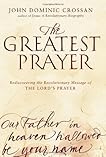
John Dominic Crossan's newest book - besides offering tremendous literally criticism and poetic insight - provides much needed depth into a subject matter that those who ascribe to liberal theology sometimes struggle with.
Accustomed as we are to a Christian tradition that all too often reduces prayer to "asking God for things," but at the same time philosophically unable to think of God as a person-like being, we simply don't know what do to with prayer; or as Paul of Tarsus (quoted approvingly and used at length by Crossan) puts it "We do not know how to pray as we ought" (Rom. 8:26).
Crossan shares a rejection of any crude anthropomorphic understanding of prayer, "it is an immature view of prayer that addresses a Supreme Being radically apart from us who thinks, and wills, knows and hears, grants and refuses more or less as we do, but with infinite broadband" (28).
Noting that the Prophets of ancient Israel seem to reject prayer and insist that God requires distributive justice (care for widows, aliens, and orphans) instead of prayer and ceremony, Crossan nonetheless does not think we are faced with some either/or. For him, prayer and justice are distinguishable but inseparable. Like two sides of a coin, we cannot have prayer without justice or justice without prayer (20-21).
From this starting point, Crossan turns to the most well known prayer in the Christian tradition, variously called the "Our Father," or the "The Lord's Prayer." This prayer, Crossan argues, expresses the heart of the message of Jesus. The prayer asks us to come together as equals, to become heirs of God, and to work together to establish the divine reign here on earth. We do this by sharing with each other fairly and equally.
Crossan spends much of the book describing the vision of an egalitarian justice found throughout the pages of the Bible. Most striking is his thouhtful examination of the use of the Sabbath tradition. Crosssan argues, persuasively, that the Sabbath is the crown of creation in Genesis Chapter one, and that the later traditions of the weekly Sabbath, Sabbath year (every Seventh year), and year of Jubilee (a kind of super Sabbath every fiftieth year), is designed to recall and enact a world of unity, non-violence, equality, and peace. His discussion of the Sabbath is among the finest I have read.
Prayer, Crossan argues, is meditation on the divine vision of a just, fair, peaceful, and non-violent world. The message of Jesus is a message that we can and must work together with God to bring about such a world. When we pray, then, "The Lord's Prayer," we remind ourselves that God and God's kingdom are present only when share our resources, forgive others their debts, and work together for peace, and that God's kingdom will only be fully present when ALL have enough, when ALL debts are forgiven and when ALL people are free to live together and live peacefully.
The book builds on Crossan's earlier work, especially God and Empire, and most of the themes are found throughout his writings. Yet there is a freshness to the presentation here, an application that warrants attention. Although most of the themes are not new for Crossan, how those ideas effect our prayers, and particularly how we say "The Lord's Prayer" is a novel application of them.
If you are open to non-traditional Christian theology and a faith informed by reason and historical method, this is the prayer book for you.
If only Dr. Cornel West were White House Chief of staff (and Paul Krugman chief economic adviser for that matter) ... alas we are stuck with Summers and the gang.
In any case, enjoy the the following video of Cornel West:
In most of the world today May Day will be honored as a celebration of the rights of working people. This is a day to champion their cause, to celebrate their labor, and to think of ways to improve working and living conditions for working people everywhere.
In honor of May Day, I offer the following book review:
It is no secret that nearly all human societies - including our present societies - favor the rich and powerful at the expense of everyone else.
The dominant institution for implementing this type of exploitation today is the corporation. Corporations get politicians elected, take over our minds with advertising, dump pollution into our environment, and routinely commit crime upon crime.
The basic Premise of this book is fairly simple: Corporations are not run by evil people, but are systematically designed in such a way that harming and exploiting people is a necessary component of their operation. Corporations are created to maximize profit and minimize cost. Corporations are legally bound to put profit above all other concerns. These claims are backed up by an enormous amount of legal data.
The second point is that currently Businesses are insufficiently regulated and not remotely penalized severely enough for their crimes. This means that, given that their structure is to maximize profit, they will lie, cheat, fraud, and harm consumers and employees - as this is in the long run the most profitable course.
What is the solution to this? A rethinking of and legal rewrite of the purpose and function of a corporation. Instead of merely a profit making machine, a corporation, the author argues, should be highly regulated, and subject to severe penalties when it violates the law. Furthermore, social responsibility must be legally written into the charter of a corporation and the common good, not merely profit, must be part of their tasks as a social institution.
Only by so re-creating the corporation and its structures can we remove the horrible harms corporations do and make them a force for good, rather than a force for harm and destruction.
As we celebrate the workers of the world this May Day, let us not only honor their labor and speak out for their rights; let us also come to understand the systemic problem of the corporate structure which keeps them exploited.
If we are to have true rights for working people, then we must restructure the corporate machine into something very different
Bill Moyers has ended The Journal. It is possible to make too much of this. Moyers will still be around and will not be entirely silent. He will, however, no longer host a regular television show. Though this may very well be the right thing to do for the soon to be 76 year old journalist, it is a sad thing for the rest of America.
Much could be written about Moyers' contribution to journalism. From his time in the White House as press secretory and his impact on the founding of the Peace Corps, to his interviews with Joseph Campbell, on death and dying, and on world religions - to name but a few of his many creative and informative projects. But others have done this far better than me. I refer to Eric Alterman's fine piece on what Moyers has meant to journalism and the country and Fresh Air's thoughtful retrospective involving past interviews with him.
There is little I can add to the tributes I mention. I will say only this: In an age dominated by partisan hacks and pompous blowhards, when shock jocks are the norm and vulgarity toward one's opponents encouraged, Bill Moyers remained a Christian Gentleman.
Always courteous, kind, generous, respectful and well-mannered, Moyers nevertheless spoke the truth to power with courage, stood on principle no matter what, and battled against power interested for the good of working people everywhere.
He has beenthe most honest man in journalism.
Moyers' professionalism, commitment to truth, openness to others, and above all genuine integrity and humanity have seldom been seen together in a single newsman.
It is above all his combination of passion for truth, commitment to principle, compassion for his fellow human beings, together with his generosity toward others, respectful tone, courteous manner, open mind, and refusal to engage in the smear tactics and name calling that have dominated journalism and media for some time now, that make him a personal hero to me - (I concede by the way that I've not measured up to his standard here).
Mr. Moyers will be greatly missed by many of us. As for his replacement? Let us be frank: Moyers is NOT replaceable. He is a unique contributor to American Journalism. But we can carry on his mission.
We must all pick up Bill Moyers' mantle. Let us also strive, like Moyers, to seek the truth with gentility, kindness, openness, but also with perseverance, integrity, and a desire for truth over pleasing those in power.
Let's continue to fight his fight!
Let us make it our own.
Here are some of Moyers' parting thoughts (from the second to last episode, not the last):
Today is Holocaust remembrance day. A day we remember, with great sorrow, the horrors of the Holocaust. The Holocaust was the end result of centuries of persecution and hatred directed toward the Jewish people and others. As one of the worst atrocities of history it is good to look to it and try to learn from it, learn how to stop it.
Sadly it does happen again. Often. The world is still full of hate, persecution and violence. We have, apparently, not yet learned our lesson. Perhaps we never will.
But there is hope.
On this Holocaust Remembrance day, let us commit ourselves to non-violence, inclusion, equality, forgiveness, healing and peace.
Maybe if we truly make that commitment it will really never happen again.
On Good Friday Christians around the world commemorate the death of Jesus. I confess I've never been able to entertain the strange notion that Jesus' death magically takes away our sins.
There are various versions of how this works: the most common being a very primitive and barbaric suggestion that Jesus died in our place. Such a claim presents a view of God that is hardly lovable.
So I don't prefer to think of today as the day of remembering how Jesus "died in our place" or some other such weird notion.
What I choose to remember is that Jesus was crucified by imperial power. The reason, historically, that Jesus was executed - think about that executed! - was because he disturbed the status quo. In the name of the Kingdom of God - the Jewish God of justice and peace - Jesus condemned the ways of empire, and the system of domination and exploitation.
The death of Jesus was a direct result of his passionate commitment to peace, justice, and compassion in the name of God and God's kingdom. That is what ought to be remembered.
The great Medieval theologian Peter Abelard argued that Jesus' death should not be understood as a substitution or a ransom paid, but as an example of divine love. An example that, if we truly contemplate it, transforms us so that we become better people.
Abelard, it seems to me, was right. The importance of the death of Jesus is that it shows how committed he was to the central goal of his life, and inspires us to be just as committed.
The religious importance of this death, for Christians, is this: Jesus' death was not merely the result of his commitment to justice and compassion. Rather, it was also his firm conviction that God is found chiefly in a life of Justice and compassion; a life he himself embodied.
Note: I originally published this post last year. I thought it worth re-posting
Today is Holy Thursday, the day when Christians remember the last supper, the foundation of that most sacred of Christian meals, the Holy Communion.
It is historically very uncertain if the accounts of the last supper actually go back to the Historical Jesus or if they are later constructions of the church. My own inclination is that Jesus did celebrate a "last supper" with some of his followers. I doubt he said the "words of the institution," but I suspect he asked them to "remember him while they ate and drank." But perhaps not even that is historical. There is something more important about this meal.
In standard Christian theology Holy Communion is deeply connected with Jesus "dying for the sins of the world." I'm not very interested in that theology. Jesus' death is very important. He was put to death by an Empire and a leadership that despised everything he stood for to make an example to would be rebels. That death is, in many ways, a profound conclusion to his life and mission. But I don't believe in vicarious sacrifice or magic rituals, so the "dying for our sins" part does not move me. I am, however, deeply moved by the ritual of Holy Communion.
Communion reminds as that we are all one, like cells of one body, and that we were meant for "life together" in Boenhoffer's phrase. It is also a reminder that God is intimately near to us, as near as the bread and wine we digest. But there is more to the ritual even than that. Eating together was a (perhaps the) central element in the ministry of the historical Jesus.
Historians and New Testament scholars are unanimous in recognizing an "all-inclusive table fellowship" or "open commensality" as a central practice of the ministry of Jesus. In the ancient world who you ate or did not eat with mattered very greatly. Table Fellowship was a microcosm of the lager society, you did not eat with the the "lower people" or "outcasts."
Jesus directly challenged this ancient table practice with his own. Jesus dined with all manner of people, rich and poor, righteous and sinner, outcast and respectable soul, tax-collect and harlot, P and scribe. For Jesus, all set together to dine as equals. Jesus, from all accounts, appears to have been principally concerned with undoing the divisions of society. His ministry of eating and healing appears to have been designed to radically transform human relationships from exclusive to inclusive, from hierarchical to egalitarian.
The practice of all eating together as equals was the realization of Jesus' vision. In having all dine together as equals, Jesus was not merely proclaiming, but actually destroying the boundaries that divide. No one was to be an "outcast" any longer.
It all probability that is what communion grew out of - Jesus' mission to unite us all; to break apart the divisions which cause strife between us.
So if you take communion tonight or anytime this Holy Week do indeed remember Jesus. But forget theological claims about his divinity or sacrificial death (I suspect that the Historical Jesus would have found such claims a profound waste of time) try to remember his mission to unite, heal, reconcile, and bring together.
In a world still so divided and marred by the violence of those divisions, perhaps it would be good to remember Jesus' call to unity and to try to live it a little.
Today is Palm Sunday, the beginning of Holy Week for Christians. On Palm Sunday Jesus enters Jerusalem riding a donkey, hailed by followers waving palm branches. The action is a deliberate symbolic protest.
Biblical Scholar John Dominic Crossan pinned an article just two days ago which explains exactly what Jesus was up to:
Jesus went up to Jerusalem to make twin demonstrations, first against Roman imperial control over the City of Peace and, second, against Roman imperial control over the Temple of God. In other words, put personally, against the (sub)governor Pilate and his high-priest Caiaphas.
Together with his friend and colleague Marcus Borg, Crossan wrote an excellent book a few years back with elaborates and clarifies Jesus purpose in Jerusalem: The Last Week. Early in this book they explain that:
The Meaning of the demonstration is clear, for it uses symbolism from the prophet Zechariah in the Jewish Bible. According to Zechariah, a king would be coming to Jerusalem (Zion) "humble, and riding on a colt, the foal of a donkey" (9:9).... The rest of the Zechariah passage details what kind of king he will be .... This king, riding on a donkey, will banish war from the land - no more chariots, war-horses, or bows. Commanding peace to the nations, he will be king of peace.
Jesus' procession deliberately countered what was happening on the other side of the city [that Sunday, Pilate entered the city in a pompous pro-empire procession]. Pilate's procession embodied the power, glory, and violence of the empire that ruled the world. Jesus' procession embodied an alternative vision, the kingdom of God.
The kingdom of God is the heart of Jesus' life and message. Dedicated to non-violence, inclusiveness, justice for the poor and afflicted, and peace through justice for all, Jesus entered Jerusalem intentionally opposing his message and his mission to the power and injustice of empire.
The problem with Rome and the Priesthood for working so closely with Roman power. Was that this power disenfranchised, exploited, and oppressed the peasantry (a good 90% or so of the population) simply to create wealth and power for the elites.
Or to quote from Crossan once more:
After centuries of subjugation to various empires, the Jews of Jesus' time wanted to know: if God is just, and the world belongs to God, why is the world so unjust? One stream of Jewish tradition answered that question with this mantra: God will overcome, someday. At some point in the future, God would not only clean up the mess but also create a perfect world....
[To fight against Roman imperial power] Jesus told his companions to heal the sick, to eat with those they healed, and to announce that the Kingdom of God had arrived. Healing is the basic spiritual power. Eating is the basic physical power. That mutual sharing of spiritual and physical power, in a sense, recreated the sharing aspects of peasant life in contrast to the greedy life under Antipas' Romanization process.
Think about those twin aspects for a moment. Those who bring healing and those who furnish eating are not exactly in the same position. They represent, respectively, itinerants and householders. By itinerants, I mean people pushed off family farms or family boats as the New World Order arrived in Lower Galilee.
Think, for example, of how readily fishermen followed Jesus. By householders, I mean families who know how easily they could lose their own farms or boats in a changing economy. As itinerants and householders faced one another, the former saw where they had been, and the latter saw where they could be. The program of the Kingdom was to join both groups in support and common life.
In Leviticus 25:23 God says that, "The land shall not be sold in perpetuity, for the land is mine; with me you are but aliens and tenants." Land is life itself and cannot be bought and sold like other commercial commodities. In the gospels and throughout the New Testament there is little said about land and much said about food. But the continuity is clear--land is there for food, and the basis of life is land because it produces food.
Jesus' Kingdom program was not just about politics or economics as distinct from theology. It combined religion, politics, and economics; it was about divine distributive justice; it was about the ownership of this world; it was about a theology of creation ("Jesus' Kingdom Program" Belief-net).
In other words, Jesus challenged his hearers to disobey Roman power by living in God's kingdom here and now. In effect he claimed that Roman authority was null and void, that the Temple leadership was dissolved, and that God was ruling in our midst. No wonder the authorities killed him!
To follow Jesus, therefore, is to oppose the forces of empire and violence. To fight for the radical inclusion and healing of all people.
Palm Sunday offers us a choice: we can follow Jesus the messiah of peace and justice, or align ourselves with the forces of empire. THAT is the gospel; THAT is the passion of Holy Week. UPDATED: APRIL 1, 2012
Michael Moore's latest film is out on DVD. It's a usual Moore flick. Some good insights, funny, but one-sided, sometimes superficial, and lacking at key points in depth. It is surely among Moore's better films and does reveal a great deal of crucial information about how our economic system is run ... or better, run into the ground.
Some of it, as in most Moore films, is really very well done. The best example of this is when Moore asks various financial experts to explain what a "derivative" is. In each case it is so complicated, they cannot! Very telling, and very disturbing.
The most interesting thing about this film is Moore's use of his own Catholic faith to attack Capitalism. Catholic economic justice runs strongly counter to our culture of greed and cut throat competition. And it is nice to hear this said. It is also nice to hear from the religious left. Too often religious messages in the media and film are right wing.
In a particularly telling and funny scene Moore dubs over an old movie about Jesus. He has Jesus mouth capitalist catch phrases, and the result is quite damning. It's impossible to imagine the Jesus of the gospels saying such things or even approving of anything like our own economic system.
I highly recommend anyone interested in the social justice aspect of Jesus' life and teaching to read Jesus a Revolutionary Biography by John Dominic Crossan. Once you have studied the figure in his historical environment, you will see that Moore has the social justice and anti-capitalism of Jesus and much Christian social justice teachings absolutely correct.
Of course the usual superficiality and pompousness of Michael Moore does hurt the film. But I think the film is worth seeing, and much of the message is well presented and substantially correct.
But if you don't have time to see Moore's film here is his October interview with Charlie Rose that pretty much sums it up:
Diogenes of Sinope is not a name one often hears. Even in the world of Professional Philosophy his name is not among the most studied minds. By way of short summary, Diogenes was a Cynic, a word which does not quite carry its contemporary meaning of a cynical and bitter person. In the ancient world a Cynic was one who repudiated - in word and deed - the entire culture of normalcy and "fitting in" that dominates the lives of most of us. For the Cynic culture is filled with injustice, exploitation, and inhumanity.
The basic idea is that social conventions and the desire for status that arises from them enslave us. Insofar as we attempt to conform to the ideals and patters of the dominant society, we are in bondage. And not only are we in bondage, but we exploit and demean one another. Only a rejection of the norms of society as binding on us can liberate and empower us.
This often took extravagant forms. Cynics frequently eschewed property and social standing - Diogenes himself was said to live in a barrel - they damned titles and any official power. Wealth, fame, and worldly success was frequently anathema to them. The logic of the cynic is that the world corrupts, society corrupts, we must return to nature and free ourselves of such corrupting influences.
One need not look far to see they have a point. The amount of hurt that has come from human beings' need for power, wealth, status, position, and comfort is truly staggering. The degree of violence, death, and needless tragedy that results from our struggle to succeed in the social world is so vast that I cannot begin to enumerate it.
Perhaps the most famous story about Diogenes is the tale of his wondering about town in broad daylight with a lantern. Asked why he was behaving in such a manner, he declared "I am only looking for a human being." The implication is that he had not found a human being. We, all of us, have failed to live up to our humanity. What can that mean? How have we failed? The injustice and villainy that fill the world may be our despairing answer to these questions.
In a world where the rich continue to prosper at the expense of the poor, a world where violence is the norm, discrimination an every day occurrence, injustice, brutality, anger and hate commonplace, have we yet to find a human being? Have any of us lived up to what we might be?
Need we light the torch brighter? Or does Diogenes' lamp merely reveal that there is nothing to find?
I am not crazy about the Democrats bills for health care reform. The problem with Health care in the United States is that so much of it is left in the hands of for-profit companies. This is the reason Health care costs so much (just look at the administrative costs and the regular jacking up of premiums) and the reason so many are denied coverage and claims. The bills passed by the house and the senate leave these companies with far too much power. They should be removed from the game entirely.
To quickly illustrate the problem. For-profit companies cannot maximize profits by providing good coverage. The best, perhaps only, way to maximize profits is to raise premiums absurdly often, deny care to those who need it most, and then deny every possible claim you can for any reason at all. That's really very simple. This ends up bankrupting families, causing home foreclosures, tremendous personal debt, high administrative costs (takes a lot of paper work to deny claim after claim), lack of treatment, death, misery, and ruin. No one should doubt this. Those who do are either inexcusably ignorant and/or willingly blind.
Our health care system is (by far) the most expensive on earth (for citizens and government), the only system in advanced countries that fails to cover everyone (47.5 million uninsured and rising), and the result is higher infant mortality, a shorter life-span, more chronic illness, more bankruptcy, more home foreclosures, and more personal debt than any other advanced democracy!! No one can rationally defend so broken, perverse, and corrupt a system. Ideology is useless here. The facts cannot be denied; the system cannot be defended.
Because of this there are some liberals who argue that we should oppose the passage of these bills and give up health care as "lost again this round." Part of me agrees with them. Until profit is removed from health care coverage, the United States will continue to have a health care system that is cruel, barbaric, and inhumane.
The problem, however, is that too many people can no longer afford their premiums. Too many Americans are losing their jobs and therefore their health insurance. Too many people are denied care because of "pre-existing conditions." The situation is frankly intolerable and inexcusable.
The current bill does at least alleviate some of these problems. The bill would eliminate denying care for pre-existing conditions, regulate (albeit insufficiently) how much insurance companies can raise premiums, and expand coverage - and crucially government aid to afford coverage - to millions who are currently denied it.
This bill, in short, is essential. It is not only imperfect, but poor; and yet there are parts of this bill that will really help many people.
WE MUST PASS THIS!
Make no mistake, the passage of this bill is not a final solution. Health care coverage in this country will never be acceptable until the profit motive is fully removed from insurance. Until we adopt a system like Germany and France have - highly regulated, NON-PROFIT, but private health insurance - or simply go to a single-payer system (not my choice, but light-years better than a for-profit system), our health care will remain a cruel joke. We must return to this issue again.
But the passage of a bill which eliminates pre-existing conditions, expands coverage, and slows down the rates of rising premiums will at least do some good. This might even be the first step to a functional health care system.
Republicans will rant and rave about "big government." Let them. Idiotic and uniformed morons who foam at the mouth about "socialism" should be given no more attention than lunatics on the street who pass out pamphlets informing us that "the end of days is near."
Charles Dickens' A Christmas Carol is rightly heralded as a classic that expresses the true meaning of Christmas. But not often for the right reasons.
Most film versions of the classic are overly sentimental. But the Scrooge we meet in the original novel is a man who is utterly devoid of any genuine relationships with other people. He is both dead to himself, and as a consequence dead to others. As Dickens remind us, he is "secretive, solitary, and self-contained as an oyster."
A Christmas Carol is not a Hallmark card about a stingy fellow who learns to be jovial and kind. It's a tale about the willing blindness of a man who will not listen to himself and thus shuts himself off from his fellow human beings.
The larger point is that for Dickens personal growth and transformation is inseparable from social justice and communal responsibility. If we ignore ourselves we will ignore the plight of our fellows. If we awake to ourselves, we cannot help but be moved to aid others when we can. Personal transformation and social justice are intimately linked.
In this vein the following 1972 Animated version of Carol is the best representation I have seen of the book. The film even uses as the basis for its "look" original illustrations from the 19th century.
This film not only gets the novel's concern with social justice and the plight of the poor, but also provides us with images that are very surrealist, reminiscent of a Dali painting or a Bergman film in some ways. The novel itself has these qualities, but they are not usually well captured in the various films.
Enjoy it! And remember what Dickens' Christmas Carol really has to teach us about the holiday season:
Today is St. Nicholas' Day. I think it is good on this day to take some time to reflect on generosity, love, care, and giving. But more than that. Today is also a day for reflection upon social justice and helping those in need.
Nicholas is remembered primarily as the protector of children and the poor, those who could not defend themselves and needed a protector. It is little remembered sometimes that St. Nick is not simply a figure who gives gifts to children, but who helps those who are socially marginalized and in real danger of slipping through the cracks.
The most famous story about St. Nicholas tells of his "gift" of gold in the stockings of three daughters. The gift prevented the girls from being sold into slavery! St. Nicholas did not simply bestow trinkets but battled for social justice. Another famous tale informs us that Nicholas raised back to life three abandoned children who had been murdered by an inn keeper. In both cases St. Nicholas comes to aid and protect those who have been abused and neglected.
Let us reflect upon those who suffer from injustice and poverty. Let us call upon the spirit of justice, care, and generosity that St. Nicholas embodied. Let us try to let that spirit live and work in us this holiday season.
Here you can see the Saint himself arrive to greet adoring admirers:
The Me-Attitudes