Friday, April 24, 2009

Obama fails to call the Armenian "atrocity" of 1915 a Genocide . .. or does he?

The following is my most recent submission to Huliq News:

No he did not call it Genocide. President Obama failed to call the Armenian genocide of 1915 what it was. He did this, we all know, to avoid upsetting Turkey. That is plain and simply the case

Some argue that he used the equivalent Armenian term. Perhaps, but that will not anger Turkey. Others will argue that he was fierce, telling us that his views on this matter (he has in the past called it a genocide) are unchanged. Again, that will not offend Turkey.

What Obama has done is to try to be as diplomatic as possible to all sides. He has attempted to please Armenians and those of us others who recognize this horrible genocide for what it was, while at the same time carefully avoiding offending his Turkish allies. In short Barack Obama proved today he's a calculating politician who will avoid conscience and choice to appear as likable and good as possible.

When we take this failure to call the events of 1915 a genocide, and his refusal to prosecute those Americans who tortured, we find that Obama is simply an opportunistic politician who will compromise on all sides.


However, Armen Hareyan, editor and Chief of Huliq wrote the following:

It is true that president Barack Obama did not use the word Genocide when referring to the mass killings of the Armenian population in Eastern Anatolia (today's Turkey), however, he used the Armenian very respected equivalent of Genocide "The Meds Yeghern" two times in his speech. Armenians use the phrase The Meds Yeghern when referring to the Genocide....

In other words Obama did a great political move: he satisfied both Armenians and Turkey. Today the newspapers are writing "Obama refrained from using the G word," but tomorrow all of them will write, Obama used the G. word, but the Armenian equivalent and two times in his speech. In my opinion "The Meds Eghern" is a stronger way of labeling the mass atrocities It's also a respected way of labeling the deaths.
.
Check out Armen's full response at Huliq

I am not yet sure what to think about this. Is my initial response for Huliq News correct? is Armen's article right? Or something in between? Any thoughts?

For the facts about the Armenian Genocide look here.

Bookmark and Share

Thursday, April 23, 2009

It IS torture and it is a crime


Keith Olbermann explains - with references to our own law and our own history - that we have no choice but to consider water-boarding torture and a crime:


Bookmark and Share

The Causes of Piracy

At the request of my friend and colleague Arun Iyer, I looked into the causes of piracy in Somalia.

Historically piracy is the direct result of poor working conditions, dire poverty, and systematic economic exploitation of the lower classes. As the following quote makes clear:


In an honest Service, there is thin Commons, low Wages, and hard Labour; in this, Plenty and Satiety, Pleasure and Ease, Liberty and Power; and who would not balance Creditor on this Side, when all the Hazard that is run for it, at worst, is only a sower Look or two at choaking. No, a merry Life and a short one shall be my Motto

—Pirate Captain Bartholomew Roberts


This does not mean Pirates are nice simple folk. Indeed, they are usually a rough and criminal type. But what gives them the final push into piracy is the economic despair they find themselves in. Take that away and you take away the root cause of piracy. Try simply to fight them or execute them and you just create heroes and martyrs to inspire more pirates.

Check out the following clip from Democracy Now after doing so, I highly recommend reading Two Piracies in Somalia


What is very clear from this interview and this essay is, just as in past centuries, Piracy is the direct result of economic exploitation and dire poverty. By all means arrest and punish pirates for their crimes. I think, however, the crimes that lead to piracy must also be stamped out if we are actually to end it.


Bookmark and Share

Monday, April 20, 2009

Newt Gingrich is a liar ... or he does not know history!


Rachel Maddow takes Newt and his buddies to task for their criticism of Obama's handshake with Chavez. It is very interesting that these "right wing critics" have no problem with all the dictators we "shook hands with" in the past. Just look at the picture of Rumsfield with Saddam Hussein during the Reagan years!

Oh I get it! When Bush holds the Saudi King's hand and kisses him on the cheek that's o.k. But how dare Obama bow to him?! Reagan can deal with Moscow and Noriega, but Obama can't talk to Chavez. It's o.k. for Republicans to consort with dictators and enemies, just not democrats. O.k. I get it now.


The strangest thing about this is I've yet to hear one person explain why they think Chavez is so bad a guy. What evidence do they have? He opposes American imperialism in Latin America and hated George W. Bush. That hardly places him in the ranks of Stalin and Pol Pot! Although it aligns him nicely with most of the rest of the world!

In fact, there is much positive to say about Chavez. And on any view he is hardly a dictator.


Bookmark and Share

What is a Feminist?


Friday I attended the kick off of Marquette's new Women and Gender Studies program. It was very insightful and intelligent. I like the look of the program.

I went to two talks: one focusing on concepts of gender in the Health sciences. One of the speakers there spoke of the struggles of veterans within the framework of the paradigm of conventional masculinity - a reminder that "gender studies" includes men too!

What particularly stood out to me, however, was a session called something like "Do you call yourself a feminist? What's in a label."

The Interesting points of the conversation centered on why the label "feminist" has such negative connotations and whether we should reject the label and simply embrace the views and positions.

I said there, and I repeat here, that we cannot drop labels merely because some groups heap negative connotations on them. If we allow "feminism" to be a dirty word, then once we champion feminist ideas we are inviting ourselves to be dismissed as "those rotten feminists" and considered "beyond the pale" of appropriate social discourse.

Also mentioned were basic mis-perceptions of what feminism is about, and some suggestions about what it might really be about. In that vein, I stumbled upon the following videos ... which are much in the same spirit:

First the misperceptions and ignorace:


Now an accurate view of feminism:


Bookmark and Share

Thursday, April 16, 2009

Obama says highspeed rail is coming soon

A highspeed rail system is badly needed. It will create jobs, improve travel, and if it works well reduce pollution from our overuse of cars. See the whole story here at Huliq News.

And Here is what Obama said today about his vision for the highspeed rail program:


Bookmark and Share


Wednesday, April 15, 2009

Olbermann schools teabaggers about taxes


Amen Keith! AMEN!!!!!!!!!


Bookmark and Share

Jackie Robinson and the Tea Parties


On this date in 1947 Jackie Robinson played in a major league baseball game for the Brooklyn Dodgers, breaking the color barrier and beginning what would turn out to be a huge victory for civil rights.

In honor of this man MLB commissioner Bud Selig is having every major league player wear Robinson's number (42) today. And Rightly so. Robinson was a remarkable man, not only a great ball-player, but a true hero who really cared passionately about the struggle for rights and the injustice of racism.

We should honor him. Robinson is a powerful symbol of the fight for freedom and dignity.

Today such men are too easily forgotten. As I write this today right-wing lunatics are holding "tea-bagging parties" to protest the fact that the taxes of the wealthiest Americans will rise from 36 to 39% - 10% lower than it was for most of the Reagan administration.

The following clip explains what these "Tea-baggers" are up to.


For these People allowing the Bush tax cuts to expire is a violation of fundamental human rights. Shame on them! Look to Jackie Robinson, look to the experience of African-Americans, a truly oppressed and exploited group.

How dare you lunatics whine about rich people paying a little more on their taxes?! Take a look at the American tax rates from the New deal until the end of the 1980s and learn a little history.

Instead of joining the "tea-baggers" I will spend today remembering Jackie Robinson and what he stood for and fought for.

Here's to you Jackie! Here is to those who really fight for freedom and rights!


Bookmark and Share

Tuesday, April 14, 2009

Obama's full speech on the Economy


Bookmark and Share

Padres defeat Mets in Citi Park Opener

Maybe it is the fact that the stadium was bought and paid for by a bank bailed out with tax payer dollars from me and my fellow Americans? Tax dollars given to this bank to allow it to continue to exploit and deceive people to make its executives filthy rich.

Or maybe I just don't like teams from New York? I've long hated Eli Manning and his N. Y. Giants, and every right thinking person must hate the Steinbrenner Yankees - as one must hate any evil empire. So I guess the Mets might get some of that hate too?

Or maybe I just love it when my hometown San Diego Padres win!

Whatever the motivation: it gives me great joy to announce that the Padres are the victors of the first game ever played at the new Citi Park:


Bookmark and Share

Sunday, April 12, 2009

Physical vs. Spiritual resurrection: Addition to the previous post

I want to stress a little further the difference between those who profess to believe that Jesus was physically raised from the dead and those, on the other hand, who think of the resurrection as objectively real but non-physical.

The case for a physical resurrection is made clear in this video clip:


I have to confess that this talk of Jesus moving in and out of Space-Time and the image of him taking off his death clothes and walking out of his tomb strikes me as weird. This is a thought world I cannot find myself able to live in.

The Case for a non-physical/Spiritual resurrection is made in this clip:


This view of the resurrection as spiritual but non-physical, makes a great deal of sense to me. On this view, one need not believe in the past resuscitation of a corpse, but one can have one's "eyes opened" and experience the living Jesus as a source of empowerment.


Bookmark and Share

He is Risen: The Meaning of Easter


For those who are not interested in Easter at all, this post will not matter. Also, for those who do celebrate Easter, but as a family (non-religious) holiday, or fertility festival, this post is not relevant either. I have no quarrel with these views, I merely am not addressing them here. Fertility festivals and family holidays can be very fine things, but I want to write on the importance of Easter as a commemoration of the resurrection of Jesus.

Let me state clearly that I affirm the resurrection of Jesus. There is, however, a twist. I do not believe that Jesus was physically raised from the dead. That is, I do not believe that on the third day the body of Jesus was physically transformed and his tomb found empty.

The reasons I doubt this are lengthy and complex and I will here only summarize them: 1) most crucified victims were not buried, and if by rare chance one was they were dumped in a common or shallow criminal's grave. The burial of Jesus by Joseph of Arimathea reads like a contrived tale to (a) save Jesus from this fate, and (b) help account for the resurrection in narrative terms. 2) The stories read like symbolic accounts. The resurrection is said to happen at sunrise, there are angels, the stone is magically "rolled away." This reads like legend. 3) The appearance stories in the gospels cannot be harmonized and are the clear inventions of their authors' theology. 4) It seems clear to me that by presenting the stories as they do, the gospel writers did not intend to convey literal fact. 5) Paul, our earliest Christian writer and a self-proclaimed "witness" of the risen Jesus says nothing about an "empty tomb," and strongly indicates that the resurrection of Jesus - whatever it was - was not the transformation of a corpse.

Nevertheless, I don't want to press this issue. If you believe that Jesus really did bodily rise up from the dead on Easter Sunday, and the tomb was really empty, then fine. I have no desire to combat that belief. My question is this: can the resurrection of Jesus be affirmed by one who does not believe the empty tomb story? Who does not affirm bodily resurrection?

I believe that it can.

Here is how I understand what the earliest followers of Jesus were saying: When Jesus was crucified they were afraid and they fled in despair, but they soon found that the power that they knew in Jesus was still present in them! Not only that, they felt that it was still Jesus bringing this power. That is, the earliest followers of Jesus were somehow aware (visions were most likely involved here) that Jesus was still with them, empowering them to do what he did; to heal the sick, condemn injustice, champion the poor, and include the outcasts.

I do not mean by this that they merely continued Jesus' mission or that his teaching or ideas lived on. Rather, I mean to say that the disciples of Jesus felt the "living presence" of Jesus empowering them to do as he did, and this forced them to say "Jesus lives." Jesus, they now believed, was "with God" and "with them." And I believe they were right.

Don't get me wrong, I have no idea what happens after death. I do not think traditional views of heaven and hell are likely to be true. And I have no idea if any of our personality survives death, in fact I lean against that. But I do think that something of the essence of what we are is eternal and not merely mortal. It is this contact with and experience of the eternal aspect of Jesus' being that caused his disciples to say "He is risen!"

But "Jesus Lives" is only half of the Easter proclamation. These disciples affirmed also that "Jesus is Lord." For them, Jesus did not merely continue to be with them, but to call them and challenge them, and bring to them the very being and power of their God. The risen Jesus challenges those who encounter him to radically reorient themselves; not only his presence but his call to mission is the heart of Easter faith.

I do not profess to know what kinds of experiences these disciples had. I was not there, and what we have (other than Paul) are the purely symbolic accounts in the gospels. But I am convinced that they experienced the real presence of the real Jesus as a compelling power within themselves.

The success of the Jesus movement resulted in the fact that these experiences of the "risen Jesus" were not isolated, but could be had by others. Christians who had never known Jesus during his life, could and did experience him as a "living power" calling for their authentic response.

And what was the call of Jesus? The call to "follow him." And this meant, a life committed to forgiveness, inclusion, compassion, healing, non-violence, social justice, and peace. It is this life that the risen and living Jesus still can bring to those who look to him, and to me this is what faith in the resurrection of Jesus means.

So, what happened to the body of Jesus? Presumably one of the few horrid fates that befell most crucifieds. But it is irrelevant. As the gospels rhetorically ask us, "why do we seek the living among the dead?" The spirit of Jesus lives on calling us. If we answer that call he can empower us to walk as he did and follow his way.

He is risen indeed!

Happy Easter.


Bookmark and Share

Friday, April 10, 2009

Good Friday: a Passion for Justice


On Good Friday Christians around the world commemorate the death of Jesus. I confess I've never been able to entertain the strange notion that Jesus' death magically takes away our sins.

There are various versions of how this works: the most common being a very primitive and barbaric suggestion that Jesus died in our place. Such a claim presents a view of God that is hardly lovable.

So I don't prefer to think of today as the day of remembering how Jesus "died in our place" or some other such weird notion.

What I choose to remember is that Jesus was crucified by imperial power. The reason, historically, that Jesus was executed - think about that executed! - was because he disturbed the status quo. In the name of the Kingdom of God - the Jewish God of justice and peace - Jesus condemned the ways of empire, and the system of domination and exploitation.

The death of Jesus was a direct result of his passionate commitment to peace, justice, and compassion in the name of God and God's kingdom. That is what ought to be remembered.

The great Medieval theologian Peter Abelard argued that Jesus' death should not be understood as a substitution or a ransom paid, but as an example of divine love. An example that, if we truly contemplate it, transforms us so that we become better people.

Abelard, it seems to me, was right. The importance of the death of Jesus is that it shows how committed he was to the central goal of his life, and inspires us to be just as committed.

The religious importance of this death, for Christians, is this: Jesus' death was not merely the result of his commitment to justice and compassion. Rather, it was also his firm conviction that God is found chiefly in a life of Justice and compassion; a life he himself embodied.

Bookmark and Share

Thursday, April 9, 2009

Let us honor Passover


Though I am not myself Jewish, I recognize - and think we should all recognize - the incredible influence Judaism has had on western history. Not merely the idea of one God, but of social justice, liberation, and the value of the individual person. These ideas all come to us via the Jewish people.

Let us honor therefore the Passover. Passover is the celebration of freedom, of liberation. Perhaps then the best way to honor it, is to ask ourselves to what we are in bondage? And then to ask how we can break free? We might also want to ask ourselves what freedom really means?

Enjoy the following video clip to that effect:


Bookmark and Share

Tuesday, April 7, 2009

The tide cannot be reversed: Gay marriage is here to stay

Just a quick post.

Same-sex marriage is rapidly becoming legal. The tide has, I think, turned decisively with Iowa's decision to legalize gay marriage.

First Iowa did it. Now Vermont has followed. And the trends are clear. With each passing year there is more and more support for gay marriage.

In spirit, in essence, the fight for the rights of gay people is already won. Now let's just work to make it a reality.

Bookmark and Share

Keith Olbermann Eulogizes his mother


Bookmark and Share

Monday, April 6, 2009

Take me out to the Ball Game!

Awesome! Our pastime is back!!

Here's to a fine year of good baseball!!


Bookmark and Share

Sunday, April 5, 2009

Friday, April 3, 2009

Summers Received Hundreds Of Thousands In Speaking Fees From TARP Recipients


Read the Article at HuffingtonPost

This is the last straw. Larry Summers must go. He has now demonstrated not only that he is incompetent but also corrupt.

Mr. Obama please fire Summers and find a new economic adviser.

Wednesday, April 1, 2009

The Choice


This post is inspired by a recent essay from Time Magazine.

Be sure to play the music from the video below and make the connection with the picture.

The choice is: (a) the Reagan way. Cut taxes, deregulate, give corporations free reign and slash education, health care, and social welfare and security programs, or (b) The Obama way. Tax, spend on education health care, social welfare and security, and green technology and jobs.

I have been critical of President Obama and still am, but the contrast with the Reagan ideology is dramatic and important.

As Mel Allen would say, "you make the call."


Bookmark and Share

Colbert finds us a Class A fool for April Fool's Day


The Colbert ReportMon - Thurs 11:30pm / 10:30c
The 10/31 Project
comedycentral.com
Colbert Report Full EpisodesPolitical HumorNASA Name Contest


Bookmark and Share

Obama's Orwellianism

Back to politics. The Obama Administration has apparently decided to drop the term "War on Terror." They are not however dropping the actual policies, they are simply now calling it the "Overseas Contingency Operation."

This is far too Orwellian for me! What is next Mr. President? "Oceania has always been at war with Eastasia"? Or "All animals are created equal. But some animals are more equal than others."

Although I am still glad Obama is our President and not McCain or Bush, I think Paul Krugman nailed the guy in his Op-ed column on March 28, 2008:

"Mr. Obama is widely portrayed, not least by himself, as a transformational figure who will usher in a new era. But his actual policy proposals, though liberal, tend to be cautious and relatively orthodox."
I've seen nothing so far to cast doubt on Krugman's claims, and much to fortify it.

"The purpose of Newspeak was not only to provide a medium of expression for the world-view and mental habits proper to the devotees of Ingsoc, but to make all other modes of thought impossible. . . . Newspeak was designed not to extend but to diminish the range of thought, and this purpose was indirectly assited by cutting the choice of worlds down to a minimum. . . . A Party member called upon to make a political or ethical judgment should be able to spray forth the correct opinions as automatically as a machine gun spraying forth bullets" (Orwell, 1984).

Bookmark and Share

Tuesday, March 31, 2009

Honest To God


Honest to God Honest to God by John A.T. Robinson

J. A. T. Robison's 1963 best seller is a real gem. The finest book about rethinking God and the Christian faith I've ever had the privilege to read.

Robinson's points are very simple: we must abandon the frankly unbelievable concept of a God "Out there," a supernatural person who is nothing more than a version of us writ large. Such a God is clearly no more than a psychological projection on our part. But this does NOT mean that we must abandon God.

Robinson asks us to conceive of God as “the ground of being”. God, for Robinson, is reality at its ultimate depth. The infinite power that brings all into being, and holds together all things. I have posted on this view of God before and need not say more about it here. Robinson's finest point, however, is how we experience the divine. The reality of God, Robinson claims, is experienced primarily when we love and are loved. In Robinson's own words;

"To assert that 'God is love’ is to believe that in love one comes into touch with the most fundamental reality in the universe, that Being itself ultimately has this character." (53).

None of this is original to Robinson. The idea that God is not an "old man in the sky," but the infinite reality present everywhere has been voiced by many theologians and philosophers. But Robinson clarifies and explains the concept with a force that these others do not.

Also interesting is Robinson's account of Jesus. Because he rejects all supernaturalism (he rejects naturalism as well), he cannot think of Jesus as essentially God in human form. The traditional idea of Jesus as a divine being with divine powers will not work for Robinson:

"the traditional supranaturalistic [point of view:]... suggests that Jesus was really God almighty walking about on earth, dressed up as a man.... He looked like a man, he talked like a man, he felt like a man, but underneath he was God." (66).

On this view Jesus becomes, Robinson tells us, a prince disguised as a beggar; the view must be rejected. Robinson's alternative is to remind us that love is the key to the divine ground of being, and that Jesus was the "man for others" who lived that love. In his embracing the outcasts, condemning the power structures that oppress and exploit, healing the sick, and declaring that all people should love and forgive each other as equal children of God, Jesus shows us the divine. Jesus is, for Robinson, the decisive revelation of God in a human life. And this means that existentially an encounter with Jesus is an encounter with God.

Jesus, for Robinson is not different than us in kind, but only in degree. Jesus is fully human, totally one of us, yet he shows us God like no one else. This view has become increasingly popular among mainline clergy since 1963. Essentially it sees Jesus as a paradigm for us, a man so in touch with the divine ground and depth of his being that he makes that ground and depth accessible to others.

Robinson also has fascinating chapters on prayer and on ethics, and a marvelous account of "worldly holiness" as opposed to "leaving the world." If you managed to get ahold of the 40th anniversary edition, the two essays about the book in the appendix are fine reads as well.

A great book, and I recommend it to anyone searching and questioning their spiritual life.

View all my reviews.


Bookmark and Share

Sunday, March 29, 2009

A note about Prayer

To continue blogging on this panentheism theme, I want to say something about prayer. Many panentheists hold, for various reasons, that God does not answer our petitions. In other words, if I pray to God to help my team win the big game, or my sick dog to get better, God is not the kind of entity that will intervene to answer that prayer.

Let us not concern ourselves here with why some panentheists deny the efficacy of petitionary prayer. Let us just grant for the moment their contention that such prayers cannot be answered.

I often teach panentheism in my intro to philosophy courses, and bring up this denial of petitionary prayer. Inevitably concerns are expressed about this fact. It seems that our modern culture has reduced prayer to the petitionary variety - prayer = asking God for things.

But there are other kinds of prayer that a panentheist would not only accept, but celebrate. There are prayers of adoration, in which the glory of the divine is celebrated, prayers of thanksgiving, in which we express gratitude for the world and our blessings, and contemplative prayer in which we recognize our unity with the divine.

In short, one can have a very rich prayer life without petitionary prayer. In fact, petitionary prayer should probably be thought of as prayer at its most shallow.

Geithner-Krugman Feud Comes To A Head On Sunday Shows


Excellent summary and video of Krugman and Geithner at The Huffington Post today.

Everyone should Read the Article at HuffingtonPost and see these two video clips. It is now very clear that Krugman must be listened to, and that Geithner - as Krugman has stressed - is too much of a Wall Street insider to "get it."

Be afraid, be very Afraid!

Saturday, March 28, 2009

Panentheism: The Beyond in our midst


One of my readers, responding to a previous post, asked if the view of God I am advocating is pantheism or panentheism. This terminology can be confusing, but I managed to find a video that clearly distinguishes panentheism both from classical theism and pantheism:


My position is panentheism and not pantheism. I hope the video makes that position a little more clear.

Einstein and Spinoza on God: addition to the prior post


To give the prior post a metaphysical foundation, here is Spinoza's conception of God as explained by Anthony Quinton:


And here is Einstein's view of God as explained by one of his leading biographer's:

Thoughts on God: Two Views of Deity

I'm going to shift away from my normal discourse of Ethics and Politics to focus a bit on God.

Public discourse usually assumes that the definition of God is univocal, that there is a standard set concept we all agree on. This is not remotely true, there are various conceptions of the divine. I here want to take a look at two which are dominant.

For many years now, I have rejected traditional theism. I do not believe that the universe is the artifact of a separate and supernatural "person-like" being. I do not believe in the Lawgiver, Judge, and King of popular religion. I think such a being is too easily explained as a psychological projection, is difficult to square with unanswered prayers, and not easily compatible with modern science.

Nevertheless I do believe in God. Fundamentally, I think of God as reality at its ultimate level, "the ground of being," or even reality as a whole - that which is eternal, infinite, and immanent in all things. It seems to me we have good scientific and philosophical reasons to hold that reality is, at its deepest level, absolutely unlimited; that is, eternal and infinite. This corresponds well to the ontological description of God in the western philosophical tradition.

I would furthermore say that reality as a whole, since it is the ground of our being, and source of our life, is the object of our ultimate concern. The knowledge and love of reality at its highest level is our greatest good, inspiring reverence, awe, devotion, and a sense of mystical union. This is, in the western tradition, the existential description of God.

In the following clip Marcus Borg and John Dominic Crossan explain how one can emphatically reject conventional theism, but maintain a robust belief in God:


Even though my own views are very near Borg's and Crossan's, I am not here writing to defend it, nor to attack the more conventional views. I Merely intend to note that there is more than one understanding of what "God" is.

Thursday, March 26, 2009

Peter Singer on Charlie Rose


For the full 14min interview go here:

Charlie Rose interviews Peter Singer

Singer holds the position that simply refraining from doing what is wrong is insufficient for morality, one must also - and perhaps more importantly - actively do right. Singer, in my opinion, is too extreme about what this asks of us, but I can agree with the heart of the Sentiment.

The French show us how to protest right!

Wednesday, March 25, 2009

Freedom and the Ghetto

Contemporary American society is rather quick to drop the word "freedom." We value freedom, cling to freedom, fight and die for freedom. What is seldom - if ever - asked is what this "freedom" is? Freedom from what? Freedom to what?

How do we get this freedom? What does freedom entail? How can freedom be attained? What kind of society is necessary to promote and protect freedom?

Of Particular interest to me is this: Take a child raised in a ghetto, a slum. Is he free in any meaningful sense? Sure, if he is incredibly talented and very lucky he may transcend his environment, overcome his struggles. But what are the odds?

Raised in a broken family, taught crime from an early age, living in a society where only drug dealers have the money to eat, where violence is an everyday norm, jobs are practically non-existent, and your home is a run down slum, can you really be free? Can you blame someone from such a place for being angry and desperate, uneducated and severely limited in opportunities?

My heart goes out to those who are forced to live in such awful conditions. And unless and until we recognize the systemic problems that have created these ghettos, we cannot hope to help the situation. It will simply not do to treat people coming from these areas as capable of "pulling themselves up by their own bootstraps," and overcoming their environment.

I recently discovered a blog called Ghetto America that largely takes a look at images of these urban slums. It is worth looking into it.

This sight reminded me of Elvis' song, "In the Ghetto," which I post here:


The 17th century Philosopher Baruch Spinoza declared that "The highest activity a human being can attain is learning for understanding, because to understand is to be free." But how difficult must it be for those raised in these dire circumstances to be allowed to understand enough to be truly free.

Monday, March 23, 2009

The Vagina Monologues at Marquette


The other night my fiance and I took in The Vagina Monologues at Marquette. Well, sort of at Marquette, I don't think it was officially sanctioned by the school and I'm not sure it was actually on campus grounds.

It was the first time I had seen the play (though I had seen a couple scenes acted out and heard about some others). I have to say first that it was hit. Well acted, alternately funny (Ms. Ali Fagnan acted out a monologue that had me laughing so hard my face literraly hurt), horrifying, deep, and thought provoking.

The basic premise of the play, as I understood it, is that women are alienated from their own femaleness. Patriarchal culture forces women to see themselves as the other, as the "second sex."

The symbol of the vagina is used quite nicely to this effect. A common theme in the monologues is that women find their vaginas ugly or disturbing and are called upon to see it instead as something beautiful and essential to who they are. In other words, their femaleness is not something to fear and loathe, but to embrace and celebrate.

The standard criticism of The Vagina Monologues is that it is vulgar and reduces women to their "sexual parts." Nothing could be further from the truth. The play is about empowering women to claim their femaleness as something powerful, and the language is intended to subvert hostile actions and intentions against women.

Finally, in keeping with a long tradition of performing the monologues to increase awareness of violence against women, this version of the play donated all the proceeds to pay for two surgeries to repair vaginal fistulas.

The play's candid look at violence (both physical and psychological) is probably the most remarkable and startling feature of it.

Friday, March 20, 2009

Keith is mad as hell and he has had ENOUGH

Olbmermann slams Corporate Villians!


Wednesday, March 18, 2009

Empowerment or Exploitation?

Lately I've been pondering the rise of explicit sexuality in our culture over the last 15-20 years. In particular, things like stripping and porn have become somewhat mainstream; take for instance cardio striptease classes.

Many claim that this is empowering for women, that they are expressing their sexuality. I'm doubtful. In a recent book, Female Chauvinist Pigs, journalist Ariel Levy, proclaims that there is something profoundly un-liberating about this phenomenon.

Her central thesis is that today's "raunch culture" is not an encouragement of personal sexual expression and healthy sexual appetite, but a highly commercialized and mass produced "commodity" that strips us and our sex lives of all particularity and fulfillment.

There is some video of Levy discussing this claim.

Here is Levy on the "Girls Gone Wild" phenomena:


and here she is on Playboy:


I think she raises some fascinating questions. And I wonder, when is it healthy sexual expression and empowerment, and when is it exploitation? How can we establish a clear criteria? Can we? Should we?

Tuesday, March 17, 2009

Saint Patrick's Day


Saint Patrick's day as we know it is a uniquely American phenomenon. We have created a holiday in which everyone wears green, drinks themselves into a stupor, and brags that they are 1/16 Irish.

The real holiday, it seems to me, is a commemoration of a passionate and dedicated man, St. Patrick, and a unique and marvelous People, the Irish.

Irish Christianity is quite unique and I've always found it rather appealing, as is Irish culture generally

More importantly, St. Patrick's day is the celebration of Ireland's Patron saint, Patrick.

Not much is known about St. Patrick. But he did write a book, The Confessions, which I find splendid reading. In it Patrick explains his own experience as a slave in Ireland. He was not originally from Ireland, but only went there as a slave. Eventually he escaped, years later returning to Ireland as a bishop. Apparently the motivation for his return was, in part, to transform Ireland into a land of freedom.

St. Patrick, almost uniquely before the 19th century, opposed all slavery. Having been a slave himself, St. Patrick could not stomach this awful institution. He also had, for his time, unusually egalitarian views about women.

Check out this fascinating piece from Slate about the life and passion of Saint Patrick.

This video from the History Channel in 2007 is a fine introduction to the history and meaning of the Holiday


So instead of drinking ourselves into a coma, or glibly pretending to be Irish, let us remember Saint Patrick's passion for a world in which slavery is ended, and people live together in peace. Let us equally remember the pursuit of freedom that marks the Irish people as a whole, and then perhaps we can finally really be proud of that 1/16 of us that is Irish.

Monday, March 16, 2009

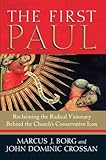
The First Paul: Reclaiming the Radical Visionary Behind the Church's Conservative Icon

The First Paul: Reclaiming the Radical Visionary Behind the Church's Conservative Icon The First Paul: Reclaiming the Radical Visionary Behind the Church's Conservative Icon by Marcus J. Borg

I always enjoy reading Borg and Crossan. This book is every bit the joy to read that their previous works have been. Scholarly but highly readable, clear, concise, and very informative.

The essential point of the book is that Paul has been misread by nearly everyone. Paul is typically read as ordering wives to submit to their husbands, condemning gays, and as offering up the Christian faith as a set of doctrines which are dogmatically asserted to be "beyond dispute." Religious conservatives read Paul this way and rejoice, religious liberals read Paul this way and recoil.

The Problem is, as Borg and Crossan see it, that this is just not Paul. To begin with, although there are 14 letters in the New Testament attributed to Paul, there is a a massive scholarly consensus that Paul surely did not write at least 4 of these, and probably only wrote 7 of the letters attributed to him. If this claim is accepted, and there is good reason to accept it, then the passages in Paul commanding slaves to obey their masters and wives their husbands vanish from the authentic Paul's writings (although even in the 7 "authentic letters" Paul still condemns homosexuality).

Borg and Crossan claim that those later "Pseudo-Pauline" letters contain passages deliberately created to subvert the real Paul's message, which was radically egalitarian - seeing all people regardless of gender, social status, etc as fundamentally equal in Christ and before God. There are numerous passages that support this reading of Paul. From his comments about inclusion regarding celebration of the Eucharist, to his constant references to and praise of female "co-workers and Apostles."

Most famously however is Paul's ecstatic assertion in Galatians (also repeated in Romans) that "There is neither Jew nor Greek, there is neither slave nor free, there is neither male nor female; for you are all one in Christ Jesus" (3:28). Add to this exclamation Paul’s request to Philemon (in the letter of that name) that he free his runaway slave Onesimus and accept him as an equal "brother," and you have Borg and Crossan's case for a "radically egalitarian" Paul. It is compelling.

Despite my admiration for their book, I have some criticism of Borg and Crossan. They downplay those passages - present frequently even in in the letters they accept as authentic - in which Paul stresses God's judgment, wrath, and exclusion of "the unrighteous." Presumably they are uncomfortable with this; so am I. But those passages display a genuine aspect of Paul's thought and they must be dealt with.

Likewise, though they correctly argue that Paul opposed the Lordship of Jesus to that of Caesar and thereby explicitly rejected Roman social norms and Imperialism, Borg and Crossan fail to adequately deal with the obvious fact that Paul had no real program for social reform. Since Paul thought Christ would very soon return to earth to establish the Utopian Kingdom of God what need was there for practical reform? Borg and Crossan recognize that Paul believed in Jesus' imminent return, but seem to brush it off as peripheral. That is problematic. Of course Paul's thought can still be made to yield a real platform for social reform, but that is a task for those of us reading Paul; Paul himself did not engage in it.

When all is said and done, however, Borg and Crossan have accomplished their task. Anyone who reads their book cannot help but come away from it with a great appreciation of Paul. Paul was not the conservative enforcer of religious dogma and hierarchy, but a radical egalitarian, whose vision was one of everlasting peace, with all people equal before, and one with, the God in whom “we live, and move, and have our being” (Acts 17: 28a).

View all my reviews.

Thursday, March 12, 2009

Manny Ramirez and the Recession


Manny Ramirez is a great hitter. And I mean it GREAT his numbers are stellar. Just check out his career totals: 507 doubles, 527 homeruns, a .314 career avg. and a .411 career on base percentage. These are not only hall of fame numbers but SUPER hall of fame numbers!

It's no surprise then that the Dodgers are paying Ramirez 45 million over the next two seasons.

The problem here is not simply that Ramirez knew he could get that much and demanded it. Just look at his numbers as a Dodger last year, we all knew he'd get that much.

The problem is how much we pay Baseball players. In short the problem is us, and not Ramirez.

We are fine with paying Manny Ramirez 22.5 million a year (in fairness, lunatic radio personality Rush Limbaugh makes even more than that at 38 million a year) but our unemployment rate is soaring. Not only that, but look at the Salary of an average teacher!

Don't get me wrong, I love Baseball. It is for me "the game of games." But something has gone terribly wrong when we value entertainment to the point that Manny Ramirez can make 22.5 million a year.

We are faced now with the worst economic crisis since the Great Depression, perhaps it is high time we as society rethought our priorities.

Note: By the way, The Netherlands beat the Dominican Republic twice this last week in the World Baseball Classic! Now that's an underdog! Go Holland!

Wednesday, March 11, 2009

It's official: recession has become depression.

Remember the tent cities of The Great Depression? Remember the dire conditions of the Joads in The Grapes of Wrath?

Just watch the video: it apears we are there again:


Is the answer still tax breaks and less government my Republican friends?

Shame on all those who brought it to this!

Ladainian Tomlinson to stay with the Chargers.


This is off topic for my blog: but I'm a die-hard Chargers fan.

I have been worried about my San Diego teams. Both the Padres and the Chargers have seemed headed in bad directions.

The Padres after all let go of Trevor Hoffman, which disappointed me until I learned that Hoffman signed with The Brewers. Since I now live in Milwaukee - that works for me!

But on that note: the Chargers were seriously thinking of parting ways with L. T. But this just in: Tomlinson is remaining a Charger!

I've hated the direction my Padres have gone, just look at the attemps to deal Cy-young winner Jake Peavy! But the Chargers, at least, seem like they still want to win.

It's good to know L. T. is not leaving the Bolts! I could have only accepted that were he traded to Green Bay - as it would bring him here.

He's not what he once was, but he still is L. T. And besides the man is taking a pay cut to stay with his team and his fans. Classy. And increasingly rare these days.

Just thought I'd share my joy!!!!!!! This is good news for us native San Diegans and Chargers fans everywhere!!!!

Sunday, March 8, 2009

Abortion: An ethically challenging case.

As many of you probably know the mother of a nine year old girl who had an abortion, and the doctor who performed the abortion, were excommunicated by the Archbishop of Brazil. This excommunication is fully supported by the Vatican.

The girl was impregnated by her stepfather who raped her. Because of her age no one suspected she was pregnant until she was four months along and started to become very ill.

The considered medical opinion was (a) pregnancy would be too much for a nine year old and (b) her hips were too underdeveloped to allow for her safety if she were to give birth (the church's position is that she could have had a Cesarean section, but that would be very dangerous also on a nine year old).

I will not ask the question of whether the Catholic Church should have excommunicated the mother and the doctor in this case. That is a theological and moral issue for the Church to work out. I am not a Catholic and therefore shall here have nothing to say about it.

But I do want to ask about the broader ethical issues involved. I hold a pretty standard liberal position on abortion. I do not think that a fetus - at least not during the first 6 months - is a person and therefore I do not believe abortion before the third trimester (after is another matter) is murder. I therefore support the legal option of abortion during the first two trimesters.

Despite this, a part of me agrees with the pro-life stance. I am not comfortable with abortions and agree that the fewer there are the better. And I completely understand where those who are pro-life are coming from and respect their position.

It seems to me, however, that in the case of this nine year old girl we have strong ethical reasons to support the option of abortion. First, this girl would have to deal with being a mother at nine. Second, she had been raped by her stepfather - that is a lot of trauma for her to deal with. Third, there was good medical reason to believe that her health - and probably the health of the babies (she was carrying twins) was in grave danger.

Can we ethically maintain that a nine year old victim of rape and incest be forced to carry twins to term and then deliver them, when the process would possibly be fatal and/or crippling to her?

I suppose much of this turns on the question of whether the four month old twins are persons. According to our best science the Cerebral cortex is not sufficiently developed to support consciousness and distinctly human thinking until the sixth or seventh month. If, therefore science is our guide, we must say that these twins are not persons.

However, the twins are potential persons, and in a strong and non-trivial sense. These twins have unique genetic codes and are developing into actual persons quite rapidly and will be persons quite soon. Nevertheless, I think it quite reasonable to hold that the rights of an actual person outweigh those of a potential person, and that therefore the real dangers to the nine year old mother take precedence in this case.

The remaining possibility of course is the position the Catholic church takes: The soul and body are fused by God at conception, so it is against God's law to take the life a fetus at any time for any reason.

I do not believe this view myself. In fact, I don't accept the traditional account of the soul. But never mind that. If we do not take this position, what grounds then do we have for saying that this abortion was unethical? On the other hand, if we do take the Catholic Position, do we have any grounds for saying the abortion is ethical? In other words, could one consistently maintain that soul and body are infused at conception but that nonetheless in extreme cases - like this one - abortions are, though regrettable, permissible?

Friday, March 6, 2009

Bedtime for Bonzo: The Gipper failed

For those out here who still think deregulation and tax cuts can help us out of the current economic crisis: Rachel Maddow gives us a history lesson about the failures of over privatization and too little regulation:


Remember this simple Tidbit: the goal of private enterprise is solely to maximize profit. The goal of public services is the common good. Public services don't always serve the common good, but private enterprise seldom does so, and when it does so serve it is accidentally.

Free Credit Report: How The Ads Soak Consumers


Read the Article at HuffingtonPost

This article about the Fraudulent "Free Credit report." Should be necessary reading for every consumer. I am myself a victim of this company, and had to file several fraud alerts with my bank to erase their monthly charges.

In fact to finally stop them I had to change my debit card number.

Remember my fellow consumers no company has your interest at heart. Every one of them has one concern: The bottom line. And they will lie, cheat, and fraud you any chance they get.

Be careful out there, and don't use Free Credit Report.

Thursday, March 5, 2009

The time is ripe for real health care reform

Barack Obama is today holding a massive conference on Health Care reform. Here are his opening remarks:


Coinciding with this, the White house has launched a new website focused on health care reform. I posted a story on this website for Huliq today.

Obama has said the right things. He said that Health care reform is not only a moral but also a fiscal imperative which requires immediate action. But already the powerful special interests that crushed the Clintons' attempt at health care reform are in attack mode.

We can't let these special interests defeat health care reform again. Look at it his way, France, Germany, England, Italy, Spain, Australia, Japan, Canada, New Zealand, Sweden, The Netherlands, Israel, Ireland and others all have universal nationally funded and regulated health care.

None of these countries have transformed into Stalinist regimes, none of them have lost basic democratic freedoms, none of them have fallen to 3rd world status. Furthermore, everyone of these countries has a longer median life expectancy, a lower infant morality rate, less diabetes, heart disease, cancer, and stroke, than the united States. And in all these places everyone is provided basic care!

Finally, the United States spends far more per capita and far more of its GDP on health care costs, largely because of the fact that its privatized system denies basic coverage to 46.5 million Americans, and leaves many others under covered. Basically the problem is, lack of necessary screenings and other preventative care.

And it's not hard to see why this is so. The goal of private enterprise is profit. If I'm an unregulated or minimally regulated health insurance company, the most effective way to make a profit is to charge premiums and deductibles at the highest cost I can, and cover as little as possible. This is why there is, for all health insurance companies, a massive list of preexisting conditions that will not be covered.

So no more lame defenses of free-market health insurance please. The data speaks for itself. We need reform and we need it now.

We can not let the insurance industry and its lobbyists crush health care reform any longer; it is time to crush them.

AljazeeraEnglish presents Focus on Gaza

Aljazeera takes us into Gaza to see the destruction and pain. The program is called Focus on Gaza

Watch it and judge for yourselves what justice demands of us:

Wednesday, March 4, 2009

Kate Winslet struggling with her role in "The Reader"

In the Following clip from her interview with Charlie Rose, Kate Winslet explains the difficulty of playing Hanna in The Reader.

This clip should help convey something of the complexity and depth of the story:


Tuesday, March 3, 2009

The Reader


The Reader by Bernhard Schlink


My review


rating: 5 of 5 stars

Bernhard Schlink's The Reader is a truly remarkable book. Without giving too much away, the novel presents a story of love, loss, guilt and atonement that is an allegory for Post WWII Germans' struggles with Germany's Nazi past.

How do you deal with the fact that you loved and learned from those who participated in something of great evil? How can you adapt yourself to a heritage of genocide and destruction? Are you guilty because you find yourself loving the perpetrators of heinous crimes? Can you, ought you, be able to forgive such criminals? These are the haunting questions of The Reader

The most intriguing and thought provoking aspect of the book is its ambiguity. We are left unclear about the motives and reflections of the character of Hanna, and not entirely sure about the moral status of the main character and narrator Michael Berg.

The Illiteracy of Hanna is used to powerfully convey how someone without the ability to read simply does not live and operate in the world the rest of us take for granted. It is chilling.

To read this book is to enter a world of uncertainty, confusion, and moral indecisiveness. It is disturbing and difficult; it will make you think a great deal.

Finally the prose style is rich and rewarding. Very polished and deeply engaging. Of course it was originally written in German and I read the translation in English, so I can't speak for the German prose.

I recently saw the film The Reader as well. The film is very faithful to the text, with appropriate adaptations and omissions. The acting, particularly Kate Winslet, is both powerful and passionate.

This story makes you rethink human nature and your moral convictions from top to bottom. I highly recommend the novel and the film.

View all my reviews.

Monday, March 2, 2009

Remember Dr. Seuss

Today is the Birthday of Dr. Seuss. Many of us learned to read with his books. Even more importantly many of us learned the absurdities of racism, materialism, and greed through his stories.

Dr. Seuss - like all of us - was not without his flaws (his depiction of and comments about the Japanese during WWII is a notorious example). But so many of us have learned so much from him, we will do well to remember the man.

In honor of this man I thought I should put up a video here of what I take to be his finest tale: The Lorax.