In the schedule of Holy Week, Monday is the day that Jesus "Cleansed the Temple." For those who don't quite recall the details of that event, here is the incident as described by the earliest gospel Mark:
Then they came to Jerusalem. And he entered the temple and began to drive out those who were selling and those who were buying in the temple, and he overturned the tables of the money changers and the seats of those who sold doves; and he would not allow anyone to carry anything through the temple. He was teaching and saying, "Is it not written, 'My house shall be called a house of prayer for all the nations'? But you have made it a den of robbers. (11: 15-17)
There is a long-standing, but misleading, tradition that sees Jesus as acting out of anger. On this view, he is angry that commerce is defiling the Holy Temple. Scholarship has largely discredited this common misreading of Jesus' action in the Temple.
Rather than throwing a "temple tantrum," Jesus is acting out a deliberate demonstration against the temple and its authorities. The commerce performed by the merchants was necessary in order to keep up the sacrifices. You had to change impure Greek and Roman coinage for pure Temple coins. This was a legitimate and proper function for Temple sacrifice. The temple could not work without these merchants.
In other words, by tossing over the tables of the money changers and prohibiting entrance to the temple (this would have had no real effect, given the temple's size. It is a symbolic protest), Jesus is symbolically destroying the Temple. His actions indicate that it's function is invalid. Jesus, acting in the name of the God of Israel, declares by his deeds that the temple and the authorities running it are null and void. They do not speak for God. They do not have legitmate status in the God of Israel's eyes.
But why would Jesus do this?
The Temple authorities were the native ruling elites who made a fortune by cooperating with Roman rule and power. As such, they profited by helping Rome exploit and demean the Jewish peasantry. In particular, Roman commericial agriculture robbed many Jewish peasants of their land, and pushed far too many people to the margins of society and beyond. Roman rule defied the Torah's notion of land ownership, and the distributive justice of the Jewish God.
For many Jewish peasants, the Priests and the Temple, no longer represented the Jewish God of justice, but rather his opposite, the gentile overlords who harmed the great majority of Jewish Peasants.
So in the name of the Jewish God of liberty and justice, Jesus condemns the Temple and its leaderships. He declares that far from speaking for the God of Israel, they speak against him; as do their Roman masters.
The meaning of Jesus' Temple actions was not lost on the Temple leaders, nor on Pilate. They quickly arrested him and crucified him. They got the message and promptly tried to destroy the messenger.
It is clear to me that those of us who follow Jesus today must do as he did. We must stand against the power structures in our own society that, like the Roman Empire of old, exploit the masses of the population in order to benefit the wealth and power of a narrow few.
For me that means we need to involve ourselves in Occupy Wall Street. This, in the United States today, is the true democratic movement (or at least has the potential to be) of our times. The 99% movement identifies the real problem, Plutocracy and Corporate power, calls it out, and seeks to find solutions to it.
Let's do as Jesus did: let's toss the money lenders from the Temple and condemn the "den of thieves" for the crooks they are.
I begin this post with two discussions. First a discussion between a group of mothers who don't vaccinate their children and a Public Health official (watch it from 45 seconds to 3:56) :
The assumption that these mother's make is that whether or not they choose to vaccinate their children is their decision alone. The possible health risks to unvaccinated, at risk groups are irrelevant - in their minds - to that decision. They either refuse to believe that there are such risks, or refuse to believe that they have a responsibility to take these risks into account. Thinking in terms of the individual apart from the community, these mothers insist that their responsibility is to themselves and their children alone; others are, presumably, responsible solely for themselves in the same manner.
The Public health official protests that when we affect the community, we cannot help but affect ourselves. If we introduce illness into our society, our own risk of illness increases as well. If we don't help take care of each other, we cannot even take care of ourselves.
The second discussion I heard today on NPR. The Supreme court is currently discussing the Constitutionality of "Obamacare." Specifically, the court is hearing arguments to rule on whether the individual mandate - which requires Americans to buy insurance or pay a fee - is permissible according to the Constitution. Whatever the fate of that particular position, some of the arguments against it put forward by the conservative Justices have a particular flavor. Listen to the following:
Just as the mothers did in the first clip, the Justices appeal to the individual first and foremost. The claim is that we cannot require this or that individual to "bear the costs" of other individuals, and that to do so eliminates (or at least greatly diminishes) their freedom of choice.
The opposition to these Justices argues in much the same vein as the Public Health Official in the Vaccine discussion did. Health care decisions never affect me solely as an individual, what happens to me directly affects what happens to others. If I don't get health insurance, and I am rushed to the ER for a heart attack, the hospital must treat me. When I can't pay, they must raise prices, insurance responds by raising premiums, and State Governments by raising taxes. To think of health insurance as nothing but an individual choice without any communal impact is not only naive, but entirely fails to consider the facts.
Behind the reaction of both the Justices and the mothers is the myth of the self-made individual. The myth holds, in spite of common sense, that whatever happens to me in life is the result primarily (perhaps even solely) of my own effort and achievement. If I get sick, that's my fault. If I'm not rich, I did not work hard enough. If I lose my home, can't afford chemotherapy, or find myself buried in debt, then I have no one to blame but me. Even worse, this myth seems clearly to advocate the position that the responsibility I have to others is negative; that is, I must not steal from them, murder them, or physically assault them, but I owe them nothing more than that.
The myth of the self-made individual is sheer nonsense.
We all owe a great debt to others for who we are and what we have achieved. We were taught to walk, talk, and even use the toilet by parents (or some caretaker). We were taught to read, write, and do arithmetic by teachers. Our character, personality, loves, likes, hates, preferences, values, and even our talents, are shaped to large degree by coaches, employers, coworkers, teammates, friends, lovers, and even casual acquaintanceships.
We are who we are because we are related to and interconnected with other people, other members of our communities.
But it's more than that. We are not little islands roving about an vast expanse of sea. What we do affects our society, and that society affects us. If we support policies that cut funding to education, cut aid to those living in poverty, dump people into prison for non-violent crimes, and fail to acknowledge the divisions of race and class that rip our society asunder, then we will be hurt by living in a less content, more violent, and less cooperative society. What we do or fail to do for our society, we do or fail to do for ourselves.
In economics the myth of the self-made individual is all too well known. Many of the super rich and their supporters argue that they must not be taxed at higher rates than the rest of us. They claim that to do so is nothing short of stealing what they rightly own.
Behind this idea is the assumption that wealthy people are solely responsible for their wealth. The help and assistance that they have received from others is marginal and negligible. They see themselves as "self-made" heroes whose hard work and intelligence has earned them their success.
The fact that many of these so-called "self-made" individuals were born wealthy, received government loans, grants, and other funding, use public roads, rely on employees who are publicly educated, depend on consumer protection laws, police, fire fighters, and other public services is not taken into account.
Furthermore, that how much money one earns depends on arbitrary factors - like being born with certain natural talents rather than others, being born in a time period in which one's talents pay off, and having one's talents, somewhat randomly favored by society - is never recognized by these self-professed heroes and their allies.
That a professional athlete, or a hedge fund manager, is paid so much more than an elementary school teacher, or a nurse, is simply a matter of the way society structures its economy; not a result of how hard these individuals work, or the result of some moral worth or inherent greatness that they posses.
We have to start thinking of ourselves as related to others, not merely encountering them like passing ships in the night. We are a community, not a collection of atomistic egos. What we do or fail to do for the broader society, we do or fail to do for ourselves.
The Following email explains it all and tells you where to sign the petition. This is a crucial issue. Student loan debt is unfair and crippling. Something must be done to protect education as a public good!
Since 1980, average tuition for a 4-year college education has increased an astounding 827%. Since 1999, average student loan debt has increased by a shameful 511%.
In 2010, total outstanding student loan debt exceeded total outstanding credit card debt in America for the first time ever. In 2012, total outstanding student loan debt is expected to exceed $1 Trillion.
In short, student loan debt has become the latest financial crisis in America and, if we do absolutely nothing, the entire economy will eventually come crashing down again, just as it did when the housing bubble popped. Reasonable minds can disagree as to the solutions, they cannot, however, disagree on the existence of this ever-growing crisis, as well as the unsustainable course we're on towards financial oblivion.
As a result of more than 30 years of treating higher education as an individual commodity, rather than a public good and an investment in our collective future, those burie d under the weight of their student loan debt are not buying homes or cars, not starting businesses or families, and they're not investing, inventing, innovating or otherwise engaged in any of the economically stimulative activities that we need all Americans to be engaged in if we're ever to dig ourselves out of the giant hole created by the greed of those at the very top.
Now for the good news: there's finally hope on the horizon! Representative Hansen Clarke of Michigan has just introduced H.R. 4170, the Student Loan Forgiveness Act of 2012, in the House of Representatives - legislation designed to lend a helping hand to those struggling under massive amounts of student loan debt.
For a brief summary of H.R. 4170's main provisions, please copy & paste this URL into your browser: http://tinyurl.com/7akydbk
To read the full version of the actual bill itself, please go here: http://tinyurl.com/6txure8
To read answers to some of the most frequently asked questions about the Student Loan Forgiveness Act of 2012, please go here: http://tinyurl.com/8xh4csd
Student loan debt has an undeniable and significant suppressive effect on economic growth. The Student Loan Forgiveness Act of 2012 directly addresses this enormous boot on the neck of the middle class and represents a glimmer of hope for millions of Americans who, with each passing day, find that the American Dream is more and more out of reach.
Therefore, we, the undersigned, respectfully request that Congress bring H.R. 4170, the Student Loan Forgiveness Act of 2012, up for consideration and commit to holding a straight, up-or-down vote on it this year. Thereafter, we, the undersigned, respectfully request that President Obama sign this legislation into law.
That's why I signed a petition to Rep. John Kline (MN-2), The United States House of Representatives, The United States Senate, and President Barack Obama, which says:
"Total outstanding student loan debt in America is expected to exceed $1 TRILLION this year. Millions of hardworking, taxpaying, educated Americans are being crushed under the weight of their educational debts, while the economy continues to sputter. Support a REAL economic stimulus and jobs plan. Support the Student Loan Forgiveness Act of 2012 (H.R. 4170)."
Will you sign the petition too? Click here to add your name:
There are two primary types of arguments offered to support the Right-Wing agenda of deregulation, cuts to social welfare programs, and tax cuts for the wealthy. The first type of argument is consequentialist. Advocates of this approach claim that cutting taxes on the wealthy, deregulating markets, and slashing social welfare programs are better for everyone. These moves will, they argue, make us all wealthier.
This is line of argument is absolutely false. The empirical data is unequivocal: the Right-Wing economic agenda benefits the very wealthy only. Wealth never trickles down, deregulation never helps main street, cuts to social welfare programs never help the unemployed and working poor. These policies have been implemented since the late 1970s, and all that has happened is that poverty has increased, middle class and working people have seen no rise in income, but have lost their pensions, their health insurance, and become buried in debt. Fewer and fewer people can own a home, send their kids to college, or pay their medical bills.
The consequentialist arguments are demonstrably, empirically, and indubitably wrong.
The second kind of argument is a moral one. The following video clip of Fox News' Stuart Varney provides a good example:
According to Varney and those who think like him, it is immoral to take more from the rich. They are entitled to what they have earned, and they are better off than the rest of us because they "worked harder" and "made themselves."
There are several problems with this type of argument:
1) The wealthy have not, as a class, worked harder than anyone else. That's just plain false. Working class people often work themselves to exhaustion and even death, and wealthy people sometimes can go years without breaking a sweat. No economic class, as a group, is divided from others on the basis of how hard they have worked.
2) There are no self-made individuals. In point of fact, there is a great deal of empirical evidence that persuasively demonstrates that, in nearly every case, the very wealthy have become so with the help of (a) being born and raised with wealth and privilege and (b) the assistance of government services and subsidies - usually more so than the rest of us. Or, as Elizabeth Warren nicely sums up in the following video:
Finally, 3), as John Rawls persuasively argues, to claim that one morally deserves X one must demonstrate that one has earned X chiefly through one's own moral or individual efforts. But this is simply not possible in the case of wealth. How much personal wealth one accrues depends on a number of arbitrary factors. First, and most importantly, wealth is often a mere accident of birth, some of us are born more or less fortunate than others. Second, often our income level is determined by our natural talents. But, although we can develop these, we cannot create them. If I do not have a talent that can earn me a great deal of money, then I will not earn a great deal of money. Third, which talents pay best is based on the arbitrary preferences of society. In our society talk show hosts and professional athletes make millions, whereas school teachers make, on average, 43,000 a year. Does a talk show host, say Oprah Winfrey, deserve to be extremely wealthy in some moral sense that a teacher does not? Hardly. The difference between her wealth and theirs depends on the arbitrary whim of society. It is, therefore, not reasonable to claim that the wealthy are morally wronged if they are taxed at higher rates than those who earn less.
The moral arguments for the Right-Wing agenda fail, just as the consequentialist arguments did.
Now turning from the Right-Wing agenda to the Progressive one, can a good case be made for the Progressive agenda of high taxes on the wealthy, strong social safety nets, and powerful government spending on the public good? Yes they can.
On consequentialist grounds the Progressive agenda is clearly a good idea. Imagine the reduction in crime if far fewer Americans lived in poverty, were well-educated, had good jobs, nice retirement plans, and access to affordable quality health care! Imagine how much better the United States would compete in the world if our schools were properly funded - not to mention the moral satisfaction in being sure that our society provides for those who are suffering, who are down and out.
Furthermore, the most prosperous time in our nation's history was the period after WWII into the mid to late 70s. During that time our income inequality was at it's lowest, unions were at their strongest, regulations at their most intense, and taxes on the wealthiest 1% of income earners was never below 70%. Coincidence? If so, then explain the fact that this boom did not exist before these policies, and failed to exist afterward. Explain the occurrence of the same trends in Europe.
More importantly, however, is the moral case for a strong welfare state. As a society we need food stamps and unemployment insurance for those who are poor, health care for all, good public schools, good public roads, parks, libraries, and community centers. We need all of these because our society is a healthier, happier, safer, and much better place when we have them in all their strength. Even those who are wealthy enough to get by with their private schools, gated communities, and personal Islands, are safer and more secure in a society where those around them benefit from good social services and programs.
Consider an analogy: Vaccines prevent deadly diseases. Not everyone, however, can be vaccinated for every disease. The elderly, the very young, some people with chronic illness or disabilities, cannot take certain vaccines. In a population where the vast majority of people are vaccinated, this is not a problem. Those who cannot be vaccinated are protected by what is known as herd immunity. Because so many people are vaccinated, the feared disease cannot enter the population and the unvaccinated persons are safe. Having myself or my child vaccinated, in other words, is not merely of benefit to me and my child, but is a public good, from which we all benefit. A community without measles or polio is much better off than a community with these dangers.
Unfortunately an increasing number of parents refuse to vaccinate their children. These parents fear that vaccines are dangerous and may even cause autism. Science has conclusively refuted these fears. Many parents, however, refuse to believe the scientific community and don't vaccinate any way. The result is that diseases like whooping cough and measles have returned. The unvaccinated have suffered because of this, often even dying as a result.
The Right-Wing agenda for economics is as irrational and as dangerous as parents who won't vaccinate their children. Because an increasing number of Americans have come to believe over the last 35 years or so - in spite of the empirical facts! - that the wealthy both morally deserve all their wealth and will benefit the rest of us by keeping it (and getting more), we have seen our social welfare programs slashed, our public services eviscerated, our social contract torn to shreds.
The result is a less educated, less secure, less healthy, more impoverished, and increasingly divided society. This is a recipe for total disaster that can, in the end, finish only with widespread rebellion, despair, and disaster.
We must now either wake up to the failure of the Right-Wing economic agenda, or watch things get much worse.
Please watch the following Episode of Fault Lines in order to understand. 1) What Unions are, 2) How they are being threatened, and 3) Why we have to fight for them:
Milwaukee is featured prominently in this episode. I lived in Milwaukee for 7 years and I've taught there for 8. It is, as the above video notes, the 4th poorest city in the country and the second most segregated city as well. Living and working in Milwaukee I can tell you first had, the policies that have been destroying this nation for over 30 years now are on full display in all their horror in Milwaukee Wisconsin.
A word about the long abandoned but even longer widely used medical treatment of Bloodletting.
According to the PBS documentary Red Gold
Phlebotomy, or bloodletting, is the longest-running tradition in medicine. It originated in the ancient civilizations of Egypt and Greece, persisted through the Medieval, Renaissance, and Enlightenment periods, flourished in Arabic and Indian medicine, and lasted through the second Industrial Revolution. The practice continued for 2,500 years until it was replaced by the techniques of modern medicine. Doctors bled patients for every ailment imaginable. They bled for pneumonia and fevers, back pain and rheumatism, headaches and melancholia; even to treat bone fractures and other wounds. Yet there never was any evidence that phlebotomy did any good.
You get the idea, a medical practice that no one had any reason to believe worked was frequently employed anyway. In fact, as everyone now knows, bleeding a sick person harms them.
It seems clear now that Republican elected officials, party leaders, and pundits are modern day Bloodletters. Even worse, given the financial meltdown of 2008, they are rather like some professional Bloodletter plying his trade after the discovery of vaccines and antibiotics!
Republican elected officials and pundits continue to argue that the economy can be fixed and jobs created only if we cut taxes further and deregulate markets and banks more. If we do so, they claim, the wealth will trickle down making us all well-off, employed, and living the good life.
This is nothing new. The "prosperity gospel" has been the official doctrine of the right wing since the mid 1970s. What I find perplexing about this dogma, however, is that such policies have been enacted - with barely a pause or a counter policy - for 35 years. Tax cuts have never created jobs (even in the Reagan era jobs were only created by Tax raises) and never boosted the economy.
The wealth has not trickled down. In fact, as all data shows only the super rich (the 1%) have benefited from these policies. The rest of us have lost our homes and our retirements, seen our health care costs soar, our policies cover less, our personal debt explode, and our incomes stagnate or even decrease. Don't believe me? Just look at the following chart:
If you still have doubts, read the information on income inequality gathered here and here. The data is absolutely clear and perfectly comprehensible: The rich gain, everyone else loses. The most dramatic deregulation and tax cuts in our history (the Bush Tax cuts, and the repeal - under Clinton - of Glass-Steagall) far from fixing, preventing, or even alleviating this trend have caused the greatest economic and job crisis since the great depression.
And, no surprise here, the last time the super wealthy had taxes this low was the roaring 20s. Take a look at one more chart and see it for yourself:
Low tax rates combined with minimal regulation right before the great depression. The exact same combination leading up to 2oo8. Mere correlation? Both in the 20s and the decades leading up to 2008? Not likely.
Ok. I can hear some right leaning readers refusing to believe me. So one last bit of evidence. Watch the Following episode of Fault Lines (Aljazerra News) on the top 1%:
And some people think - or at least claim to think - that more of these same policies will fix things!!!???
Either these folks are modern day Bloodletters or modern day snake-oil salesmen. Take your pick.
According to many versions of the Robin Hood legend, King John was in the habit of taking all of the peasants' Meager resources for his own ends. The very epitome of injustice, the vile king legalized robbery and forced the peasants into misery. He did all of this simply to make himself even wealthier than he already was.
The contemporary United States is clearly following the King John Model of Economics. We have created a system that enables a very small few to become obscenely wealthy as the direct result of policies that harm a great many of the rest of us.
Before addressing that injustice,however, we all must agree on indisputable facts. First among those facts is the massive inequality in our present American economic system.
To see just how unequal our system is consider the following chart from Bill Moyers web page:
The obvious thing to notice is that most American's incomes have not changed much over the last 30 years. The top 1%, however, has seen a massive explosion in their wealth. This is not, furthermore, a bit of good luck or hard work. The top 1% has profited directly from changes in public policy. Their taxes have been cut, slashed, dropped, and cut again ... they now pay but a fraction in taxes compared to what they did in the 1970s. Furthermore, the top 1%, consisting of largely financial industry fat cats, has made a bundle on deregulation of the banking industry. Many more examples could be cited, but you get the point: public policies have, almost without exception been geared to favor the extremely wealthy. The system has been rigged to make the richest among us even richer.
The primary defense of such a system is that allowing the top 1% so much wealth is better for all of us. It is claimed that all that wealth will eventually trickle down and find it's way into all our pockets. If the wealthy have more money, they will create more jobs, and invest in building communities. (another possible defense is to claim that it is unfair to tax the wealthy any more than we do. I have addressed this objection in another blog post, read it here)
But we have had these tax slashing, deregulating policies for over thirty years now. The wealth has NEVER trickled down. As the above chart shows, only the wealthy have seen their wealth explode greatly, the rest of us are not particularly better off regarding our income. Nor have policies created jobs. On the contrary, The American manufacturing industry has been all but destroyed, as jobs were outsourced overseas. Communities have not been rebuilt or restored, but eviscerated. We once had small family restaurants and little local book stores. Now we have only Walmart, Starbucks, and McDonalds. Small main street cities have become ghost towns, or perhaps just Walmart storage facilities.
And the cost for the 99% of us who have not benefited from the tax breaks and deregulation is that far fewer of us have health insurance, or if we do have it, it costs far more and covers much less. Not very many of us have pensions or reliable savings accounts. We are buried in debt, losing our homes, and seeing the retirement age pushed up as the amount of social security we will one day receive falls down.
There is only one truly reasonable conclusion we can reach. The massive profits of the 1% are the direct result of the huge losses for the 99%. By scamming us in the housing markets, stealing our money in the banks, denying us needed health care, wiping out our retirement, and burying us in debt, the richest have prospered almost beyond imagination.
These same wealthiest 1% drove the economy into the dust and, rather than be punished for all of the jobs they cost us, the homes they lost us, and the debt they piled on us, our government took our tax dollars and handed them over to the financial elite so they could pay bonuses and take spa days. Of course that's hardly surprising, given that our elected officials run campaigns financed by the 1%, and are thus beholden to their wealthy masters.
History tells us that the nobility of King John's age forced him to sign Magna Carta; to share much of his power and resources with them. The would not longer suffer personal injustice for the benefit of the King alone.
We are called today to force those who run our system to something far more far reaching than MagnaCarta. Any system that benefits the few at the expense of the many is an unjust and immoral system. Because our system, more than most in the contemporary democratic world, greatly benefits a very few to the detriment of nearly everyone else, it is deeply unjust.
In itself, this realization does not tell us what economic system is most just; importantly, however, we know that we are obligated to change the system we have.
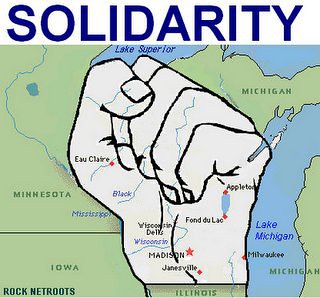
As the conflict in Wisconsin over Gov. Walker's proposal to strip unions of their right to collective bargaining continues, I find that many still do not understand what the debate is all about and why Walker's actions are terribly wrong and even deeply immoral.
First, let us dispel a few red herrings. This debate is not about whether unions have their flaws and foibles. Unions, like any other organization, have weak points, make mistakes, and are imperfect. So what? The criticisms of unions are no different than any other type organization. Second, the debate in Wisconsin has nothing to do with "balancing a budget" or "reducing the state deficit." To begin with, taking away the right of unions to bargain collectively does ABSOLUTELY NOTHING to reduce a deficit. Even worse, since Walker created the so-called deficit by giving tax breaks to his rich donors and even refusing stimulus money and the jobs that would be created by high speed rail, he can hardly say that we "must" strip unions of anything, let alone their right to bargain collectively!
Second, there are those who think this is about union members' greed. The unions have agreed - I would not have - to the cuts in their pensions and to pay more for health care. They insist only on holding onto to collective bargaining. Furthermore, many of the same people who insists that teachers are greedy for having a good health care plan also claim (out of the other side of their face I guess) that we have no right to raise any taxes on millionaires! If I hear from someone that millionaires should be given a break from their estate tax, but that teachers getting a solid pension is what we should really cut, I will simply laugh off this kind of stupidity and address it no further.
Third, I hear, all too often I am afraid, that public employees should not be given "fat benefits" that private employees lack. This is just absurd! If you think that public employees enjoy better jobs than their private sector counterparts, then you should fight to bring back union membership to private workers, to get them those "fat benefits," rather than want to remove them from public employees! Again, however, this misses the point. Unionized public employees and their allies are not fighting for better benefits, but for their right to bargain collectively! Let's please stay on track here.
These red herrings dispelled, we can now look at the justification for the existence of unions. In the employee/employer relationship the employer has all the power. The employer pays the wages, hires and fires, decides who takes breaks, when, and for how long, and so forth. If each employee must face their employer alone, they simply lack the power to fight for better wages, more time off, better working conditions, etc. The only way for employees to have anything like the power of their employer in this relationship is to come together and bargain collectively. This is what a union is, this is why unions are needed, and this is why their right to collectively bargain must be preserved.
The heart of the Battle in Wisconsin, and other states, is the battle to allow working people some power, some equality, some voice in determining their working conditions. As the collapse of unions in the private sector has already made clear, when unions go, working conditions for people fall dramatically. Without the existence of unions the power is solely in the hands of the employer, and we should all have long since understood that history clearly reveals that in any and all relationships where the power is all one side, the powerless never find themselves treated justly.
The working people of Wisconsin are under attack. The hand-picked corporate stooge that is now Governor of the state has decided to risk his entire political career and the well-being of the people of Wisconsin (admittedly the latter mean little, if anything, to him) to destroy unions, to hurt the opposing political party, and to strip away one of the very few protections left to working people. I intended to blog about what is happening in Wisconsin and what it means, but Mother Jones has already written exactly what I wanted to say! Here is what MJ says (I will add my own thoughts at the end):
Activists protesting new GOP Gov. Scott Walker's anti-union proposals have occupied the rotunda of the Wisconsin capitol building in Madison for the past week, but Walker is pressing ahead anyway.Flickr/Peter Gorman.
For days, demonstrators have been pouring into the streets of Madison, Wisconsin—and the halls of the state's Capitol building—to protest rookie Republican Governor Scott Walker's anti-union proposals. Big national unions, both major political parties, the Tea Party, and Andrew Breitbart are already involved. Democratic state senators have fled the state to prevent the legislature from voting on Walker's proposals. And the protests could soon spread to other states, including Ohio [....]
What's actually being proposed?
Walker says his legislation, which would strip most state employees of any meaningful collective bargaining rights, is necessary to close the state's $137 million budget gap. There are a number of problems with that argument, though. The unions are not to blame for the deficit, and stripping unionized workers of their collective bargaining rights won't in and of itself save any money. Walker says he needs to strip the unions of their rights to close the gap. But public safety officers' unions, which have members who are more likely to support Republicans and who also tend to have the highest salaries and benefits, are exempted from the new rules. Meanwhile, a series of tax breaks and other goodies that Walker and the Republican legislature passed just after his inauguration dramatically increased the deficit that Walker now says he's trying to close. And Wisconsin has closed a much larger budget gap in the past without scrapping worker organizing rights.
What's really going on, as Kevin Drum has explained, is pure partisan warfare: Walker is trying to de-fund the unions that form the backbone of the Democratic party. The unions and the Democrats are, of course, fighting back. The Washington Post's Ezra Klein drops some knowledge [emphasis added]:
The best way to understand Walker's proposal is as a multi-part attack on the state's labor unions. In part one, their ability to bargain benefits for their members is reduced. In part two, their ability to collect dues, and thus spend money organizing members or lobbying the legislature, is undercut. And in part three, workers have to vote the union back into existence every single year. Put it all together and it looks like this: Wisconsin's unions can't deliver value to their members, they're deprived of the resources to change the rules so they can start delivering value to their members again, and because of that, their members eventually give in to employer pressure and shut the union down in one of the annual certification elections.
You may think Walker's proposal is a good idea or a bad idea. But that's what it does. And it's telling that he's exempting the unions that supported him and is trying to obscure his plan's specifics behind misleading language about what unions can still bargain for and misleading rhetoric about the state's budget.
Walker's proposals do have important fiscal elements: they roughly double health care premiums for many state employees. But the heart of the proposals, and the controversy, are the provisions that will effectively destroy public-sector unions in the Badger State. As Matt Yglesias notes, this won't destroy the Democratic party. But it will force the party to seek funding from sources other than unions, and that usually means the same rich businessmen who are the main financial backers for the Republican party. Speaking of which....
Who is Scott Walker?
Walker was elected governor in the GOP landslide of 2010, when Republicans also gained control of the Wisconsin state senate and house of representatives. His political career has been bankrolled by Charles and David Koch, the very rich, very conservative, and very anti-union oil-and-gas magnates. Koch-backed groups like Americans for Prosperity, the Cato Institute, the Competitive Enterprise Institute, and the Reason Foundation have long taken a very antagonistic view toward public-sector unions. They've used their vast fortunes to fight key Obama initiatives on health care and the environment, while writing fat checks to Republican candidates across the country. Walker's take for the 2010 election: $43,000 from the Koch Industries PAC, his second highest intake from any one donor. But that's not all!:
The Koch's PAC also helped Walker via a familiar and much-used political maneuver designed to allow donors to skirt campaign finance limits. The PAC gave $1 million to the Republican Governors Association, which in turn spent $65,000 on independent expenditures to support Walker. The RGA also spent a whopping $3.4 million on TV ads and mailers attacking Walker's opponent, Milwaukee Mayor Tom Barrett. Walker ended up beating Barrett by 5 points. The Koch money, no doubt, helped greatly.
What are the Democrats and the unions doing to respond?
Well, they're protesting, obviously—filling the halls of the Capitol and the streets of Madison with bodies and signs. They're calling their representatives and talking about recalling Walker (who cannot be recalled until next January) or any of eight GOP state senators who are eligible for recall right now. Meanwhile, all of the Democratic state senators have left the state in an attempt to deny Republicans the quorum they need to vote on Walker's proposals, but if just one of them returns (or is hauled back by state troopers), the GOP will have the quorum they need. (Interestingly, the head of the state patrol in the father of the Republican heads of the state senate and house of representatives, who are brothers.) Finally, Wisconsin public school teachers have been calling in sick, forcing schools to close while teachers in over a dozen other school districts picket the capitol, plan vigils, and set up phone banks to try to block Walker's effort.
How could this spread?
Other Republican-governed states are trying to mimic Walker's assault on public employee unions. The GOP won a resounding series of state-level victories in high-union-density states in November. Now they can use their newly-won power to crack down on one of the Democrats' biggest sources of funds, volunteers, and political power. Plans are already under consideration in places like Ohio, Indiana, and Michigan.
Speaking of Ohio:
As Suzy Khimm outlined on Friday, an estimated 3,800-5,000 protestors came out in full fury in Columbus, Ohio, to vent their anger over a similar anti-union bill that would limit workers' rights to bargain for health insurance, end automatic pay increases, and infringe upon teachers' rights to pick their classes and schools. As in Wisconsin, both the Ohio state house and governor's mansion flipped from blue to red last year. "This has little to do with balancing this year's budget," former Governor Ted Strickland told the AP. "I think it's a power grab. It's an attempt to diminish the rights of working people. I think it's an assault of the middle class of this state and it's so unfair and out of balance."
How are conservatives working to support Walker?:
It was only a matter of time till the Tea Party got in on the action. Stephanie Mencimerreports that activists are bussing into Madison, and are "promising a massive counter-demonstration." The push is being led by American Majority, a conservative activist group that trains impressionable young foot soldiers to become state-level candidates (check out their ""I Stand With Scott Walker Rally" Facebook page). Founded by Republican operatives, the well-funded group (which, according to tax fillings, had a budget of nearly $2 million in 2009) gets much of its money from a group with ties to those adorable Koch brothers. Conservative media baron Andrew Breitbart will be leading the rally, and will be joined by presidential candidate Herman Cain and maybe—if we're lucky—Joe "The Plumber" Wurtzelbacher. Expect fireworks.
I wish to add to Mother Jone's analysis only this: The rights of workers in this country are under serious assault. This is an absolutely historical moment. If we fail, if Walker successfully destroys the unions in Wisconsin, we are headed back to the age of robber barons and unaccountable corporate power. We have already taken too many steps in that harmful and unjust direction. Not only must we stop walking toward such an abyss, it is time - NO LONG PAST TIME! - that we turned around and walked the other direction.
Labor Day has come and gone. The ceremonial ending of summer, a holiday - for federal workers, but not many of the rest of us - has been celebrated, grills made use of. Sadly, however, we find the outlook less than rosy on this holiday meant to honor working people.
It has been some time since being a working person in America has been a worse bargain. Unions - which give workers their only power to bargain for fair wages and decent benefits against massive corporations and other big employers - have been, with some notable but few exceptions, abolished, or at least broken and neutered, rendered impotent by pro-corporate legislation passed by the bought and paid for members of the United States Congress and White House, over the last 30-35 years. The gulf between rich and poor continues to grow and the those who are not rich are seeing their standard of living drop further and further.
Our current economic collapse shows no real sings of abetting, and nobody is adding jobs. Even federal employees, once thought safe from such disasters, are seeing their wages and benefits reduced.
To borrow a phrase from Obi-Wan Kenobi, "it is a dark time for the empire."
I would like to say something optimistic, to praise working people, and to argue that they can get some of their rights and power back. And indeed, I am quite sure that they can do so. But the immediate outlook is grim.
By pursuing fairly conservative economic policies, by eschewing more progressive ideas, Obama has failed to create jobs, failed to boost the economy. The stimulus was too small, too weak, too focused on tax cuts and minor lending. There was no real attempt to move the country toward a green economy, which would have created far more jobs, no attempt to hire more teachers, no attempts to bolster public service ... at least no more than minimal attempts. Apparently when we require money to build bombs, bail out banks, and kill people in distant lands, we have a bottomless pit of funds, but when it comes to building better roads, hiring more nurses, hiring teachers and paying them better, funding public libraries, and so on, we just "can't spare the cash."
Obama, I think, did this because he did not want to seem too "radical" too "liberal." And what has he accomplished? In all probability a radically far right, and, to be honest, rather crazy, GOP will probably take control of both houses this November. They will undo even the minimal gains Obama's white house has brought us. They will hurt working people more than they ever did before.
Ironically, many working people will vote in to office the very hacks and liars who are going to destroy their livelihood even further than it has already been destroyed.
Not only is it a dark time for the empire and for working people, but, to quote now from the Scarecrow in Wizard of Oz, "I can't be sure, but I think it's gonna get darker before it gets lighter."
At a time when we are losing our democracy to the interests of the rich and powerful, we should be reminded what Democracy is, how we got it, and what we must do to keep it.
With that in mind, I offer this video, from a few years back, narrated by former MP Tony Benn:
I think Benn is correct. We have never really had much democracy, we have had to fight hard for what little we do have, and we better keep fighting hard to stop losing it and to get more of it.
Please sign the above position to tell your president that we want Elizabeth Warren to lead our consumer protection agency. She is one of the few people who combine the competence, energy, honesty, and real concern for the people who we have in Washington.
This is, for once, a chance to put a real democratic populist in a position that can do people good. She is not a stooge for the big banks, nor a wall street puppet; unlike most of the people in D. C.
Today is Palm Sunday, the beginning of Holy Week for Christians. On Palm Sunday Jesus enters Jerusalem riding a donkey, hailed by followers waving palm branches. The action is a deliberate symbolic protest.
Biblical Scholar John Dominic Crossan pinned an article just two days ago which explains exactly what Jesus was up to:
Jesus went up to Jerusalem to make twin demonstrations, first against Roman imperial control over the City of Peace and, second, against Roman imperial control over the Temple of God. In other words, put personally, against the (sub)governor Pilate and his high-priest Caiaphas.
Together with his friend and colleague Marcus Borg, Crossan wrote an excellent book a few years back with elaborates and clarifies Jesus purpose in Jerusalem: The Last Week. Early in this book they explain that:
The Meaning of the demonstration is clear, for it uses symbolism from the prophet Zechariah in the Jewish Bible. According to Zechariah, a king would be coming to Jerusalem (Zion) "humble, and riding on a colt, the foal of a donkey" (9:9).... The rest of the Zechariah passage details what kind of king he will be .... This king, riding on a donkey, will banish war from the land - no more chariots, war-horses, or bows. Commanding peace to the nations, he will be king of peace.
Jesus' procession deliberately countered what was happening on the other side of the city [that Sunday, Pilate entered the city in a pompous pro-empire procession]. Pilate's procession embodied the power, glory, and violence of the empire that ruled the world. Jesus' procession embodied an alternative vision, the kingdom of God.
The kingdom of God is the heart of Jesus' life and message. Dedicated to non-violence, inclusiveness, justice for the poor and afflicted, and peace through justice for all, Jesus entered Jerusalem intentionally opposing his message and his mission to the power and injustice of empire.
The problem with Rome and the Priesthood for working so closely with Roman power. Was that this power disenfranchised, exploited, and oppressed the peasantry (a good 90% or so of the population) simply to create wealth and power for the elites.
Or to quote from Crossan once more:
After centuries of subjugation to various empires, the Jews of Jesus' time wanted to know: if God is just, and the world belongs to God, why is the world so unjust? One stream of Jewish tradition answered that question with this mantra: God will overcome, someday. At some point in the future, God would not only clean up the mess but also create a perfect world....
[To fight against Roman imperial power] Jesus told his companions to heal the sick, to eat with those they healed, and to announce that the Kingdom of God had arrived. Healing is the basic spiritual power. Eating is the basic physical power. That mutual sharing of spiritual and physical power, in a sense, recreated the sharing aspects of peasant life in contrast to the greedy life under Antipas' Romanization process.
Think about those twin aspects for a moment. Those who bring healing and those who furnish eating are not exactly in the same position. They represent, respectively, itinerants and householders. By itinerants, I mean people pushed off family farms or family boats as the New World Order arrived in Lower Galilee.
Think, for example, of how readily fishermen followed Jesus. By householders, I mean families who know how easily they could lose their own farms or boats in a changing economy. As itinerants and householders faced one another, the former saw where they had been, and the latter saw where they could be. The program of the Kingdom was to join both groups in support and common life.
In Leviticus 25:23 God says that, "The land shall not be sold in perpetuity, for the land is mine; with me you are but aliens and tenants." Land is life itself and cannot be bought and sold like other commercial commodities. In the gospels and throughout the New Testament there is little said about land and much said about food. But the continuity is clear--land is there for food, and the basis of life is land because it produces food.
Jesus' Kingdom program was not just about politics or economics as distinct from theology. It combined religion, politics, and economics; it was about divine distributive justice; it was about the ownership of this world; it was about a theology of creation ("Jesus' Kingdom Program" Belief-net).
In other words, Jesus challenged his hearers to disobey Roman power by living in God's kingdom here and now. In effect he claimed that Roman authority was null and void, that the Temple leadership was dissolved, and that God was ruling in our midst. No wonder the authorities killed him!
To follow Jesus, therefore, is to oppose the forces of empire and violence. To fight for the radical inclusion and healing of all people.
Palm Sunday offers us a choice: we can follow Jesus the messiah of peace and justice, or align ourselves with the forces of empire. THAT is the gospel; THAT is the passion of Holy Week. UPDATED: APRIL 1, 2012
This is the best book on Health insurance coverage that I have ever read. Anyone who wants to understand what is wrong with the current system of health insurance in the United States and what the genuine options for reform are must read this book.
The well-known facts of the troubles with our health care coverage are here: Millions uninsured, millions more under-insured, homes lost and personal bankruptcies endured even by the fully insured, premiums rising three to four times as fast as wages, more and more claims partially or wholly denied by health insurance companies, and our GDP being eaten up by the huge costs of our private health care system.
Unless one is ideologically blind or simply radically uniformed, these facts are well known, well documented (Kaiser family foundation, various Harvard studies, Commonwealth, WHO, CBO) and all too real to millions of suffering Americans. What is less well known is how other countries provide better insurance companies.
No other country spends anything like what we do on health care. Despite this, nearly every other industrialized country has better outcomes; longer life-spans, more healthy years after 60, less infant mortality, and better treatment for chronic ailments and they do all this while providing basic health care coverage to every man woman and child in their country.
This is where Reid's book makes its best contribution. In the United States both Liberals and Conservatives frame the debate as a contest between "socialized medicine" and our current "free-market" health care system. Liberals point to the abuses of a private-for-profit system and argue that we must have a single-payer system, a system in which the government pays all the bills (though doctors and hospitals are still private). Conservatives rage against this, fearing long waits, rationed care, and diminished quality.
Reid demonstrates that this debate between single-payer and free-market approaches creates a false dilemma. There are a number of ways in which other nations provide universal and affordable health care. Some of these countries use single-payer and some do not. The facts are clearly against the conservative claim that the free-market is best for health care coverage. But equally the evidence strongly suggests that a single-payer is not necessary for universal coverage and quite possibly not even the best way to provide it.
Reid travels to a number of countries: France, Switzerland, Japan, The United Kingdom, and Canada. Each of these countries has better health care outcomes than the United States, covers everyone, and pays far less than we do. But here is the twist: They do not all use "socialized medicine."
The UK is closest to a socialized system with their NHS. This system does have problems with funding and sometimes results in long wait times for elective surgery. But it reports higher satisfaction than the American system. likewise, Canada offers a single-payer model in which doctors and hospitals remain privately owned and operated but the government acts as the sole insurer. This system too has better outcomes than the United States. There are, however, real problems with limited resources, long waits for elective procedures, and underfunding.
A better model is found in France and Germany. Both countries use something called the "Bismark" model. This model relies on private doctors, private hospitals, and even private insurance. But the private insurance in France and Germany is nothing like its American counterpart. In these countries the government controls prices that doctors and hospitals charge, insurance companies are required by law to cover every claim sent to them, and are non-profit social businesses; they don't make money for CEOs and investors. Furthermore, Employers are required by law to cover their employees and everyone is legally required to buy insurance.
France and Germany have far better health outcomes than the United States (and even than England and Canada) for far less costs. Even better, France and Germany have shorter wait times than not only Canada and England, but also the United States. Everyone is covered and patient satisfaction is very high. This is what happens when the profit motive is removed from health care.
Reid concludes with a moral case for Universal and affordable health care. It is, he argues, simply a moral duty for a society to cover all its members. A civilization that allows only those who can afford it access to care is neither democratic or fair. If we wish to fulfill our moral duty we must recognize the right of all to affordable health care.
Reid did a documentary on the same theme as this book for Frontline. It is well worth seeing and can be found in its entirety here