I teach a number of Ethics courses each semester. These courses are very enjoyable for me, and I hope for my students as well. Each time I introduce an ethical theory I look for its foundational principle: its central proposition from which it determines the rightness or wrongness of particular actions. For instance, Libertarians ground all of their determinations about what is right and wrong in a principle of self-ownership, Deontologists in a list of universal moral rules, Utilitarians in the greatest amount of happiness that can be produced, Human Rights Theorists in some list of basic rights.
The problem with all of this is that it is terribly abstract. Traditional moral theories propose a solution to the problem or right and wrong that fails to take into account the genuine motivation behind human goodness. Conceiving of morality as something like a math problem to be solved by the dry and impersonal calculations of reason, such theories forget that our our initial impulse toward acting morally is concern for and empathy with our fellows.
Compassion for others (be they human or animal) is the fire from which morality burns. The reason we strive to be good is that we care about others. We desire to help them, to keep them from harm, to accord them the same treatment we would like for ourselves. Without this initial compassion for others, the spark of morality fails to ignite and considerations or right and wrong are not possible.
Consider the activities of the most deranged among us: Do mass shooters, serial killers, and other sociopaths care for others? Clearly they do not. Could the SS guards have had compassion for their Jewish prisoners? The American slave-owners empathy for their slaves? Perhaps there was a flicker here and there, but without ignoring, repressing, or just plain not having the natural impulse to feel for others pain and rejoice with them in their happiness, they could not have acted in the reprehensible and inhuman manner that they did.
The origin of morality is feeling, not reason. Furthermore, it is not feeling for humanity in the abstract, but feelings for others that we actually encounter, that we actually have relationships with, that creates morality. Unless we start here, until moral theories take as their departure the central role of feelings and relationships in creating morality, we cannot hope to provide a satisfactory account of right and wrong.
This is not to say, however, that reason is irrelevant or unimportant to morality. Reason is extremely important, It is not enough to feel compassion, we must think out how best to demonstrate our compassion. We will encounter conflicts in our relationships with others and we need reason to manage them.
We cannot figure out how to act morally without reason. But reason cannot provide the initial burst that makes us moral. Without a feeling of solidarity with others, reason is a cold, calculating tool; capable of helping the Nazi gleefully persecute his victims or the serial killer calmly stalk his prey.
Where the feeling of compassion and solidarity with others is absent, there can be no morality. When it is present, there must be.
Showing posts with label Ethics. Show all posts
Showing posts with label Ethics. Show all posts
Wednesday, March 6, 2013


Saturday, April 28, 2012
Spinozoan Spirituality
The 17th century rationalist philosopher Baruch Spinoza is not usually regarded as a spiritual or religious thinker. On the surface this fact is odd. Spinoza writes of "God" so frequently that the romantic poet Novalis dubbed him "that God intoxicated man." But Spinoza's God is not the divine lawgiver and potentate of traditional western theism.
For Spinoza God is the infinite and eternal substance of which all finite things are but temporary expressions. His God is not person-like, not a law-giver nor a judge of human actions. Furthermore, his God did not create a world out of free will. For Spinoza the world is nothing more than the totality of all of God's necessary self-expressions. In fact, Spinoza goes so far as to identify God with nature itself - at least with nature understood as the active and creative power that is "reality as a whole", though not simply with the total collection of things in the world. Because of this, many have claimed that Spinoza's non-personal and absolutely non-supernatural God is really no God at all. This deity surely could never inspire us to dance, pray, love, or die for it.
And yet, there is much in Spinoza's writing to suggest that he is filled with a profound personal piety and deep spirituality toward his God. In part five his masterpiece the Ethics Spinoza argues that the ultimate fulfillment of human life is the love of God. This love fills the mind with peace, calm, and serenity. The greatest joy we can know comes from knowing God and loving God.
Commentators as diverse as the Catholic Father Copplestone and the atheist Steven Nadler have claimed that we can't take Spinoza's words too seriously here. All he really means, they argue, is that we should have an awe and appreciation of the rationality and order of nature. Spinoza, so they say, means by love "nothing more" than the joy that comes from understanding the natural world; he is not speaking about a personal relationship with a heavenly Father.
They are right of course. Spinoza does think of loving God solely in terms of understanding and appreciating the workings of the natural world. He says as much, "He who clearly ... understands himself an his emotions loves God, and so much more in proportion as he more understands himself and his emotions." (E5P15) I must confess, however, that I fail to see why this disqualifies Spinoza's thought as spiritual.
It is certainly true that Spinoza's God is not the God of popular level Judaism and Christianity. It is also true, therefore, that Spinoza's understanding of "spirituality" cannot mean love for a person-like supernatural being who can love me back in the same fashion (indeed, Spinoza specifically says that God cannot love me in any human fashion (EVP18-P19)). But are we really going to insist that spirituality and even religion must be restricted to a relationship with a supernatural and person-like being? If so, then I fear we will have to qualify a great many Buddhists, Taoists, and even many Western mystics from our definition.
Spinoza is spiritual in the sense that Carl Sagan understood that term. In Sagan's words:
When we recognize our place in an immensity of light‐years and in the passage of ages, when we grasp the intricacy, beauty, and subtlety of life, then that soaring feeling, that sense of elation and humility combined, is surely spiritual.Albert Einstein expressed much the same sentiment when he claimed that:
"The scientist is possessed by the sense of universal causation. His religious feeling takes the form of a rapturous amazement at the harmony of natural law, which reveals an intelligence of such superiority that, compared with it, all the systematic thinking and acting of human beings is an utterly insignificant reflection."This captures Spinoza's attitude perfectly. Awe, humility, reverence and deep appreciation. These are the only conceivable feelings in one who has grasped the order, unity, and sheer rationality of reality itself. Furthermore, when we understand that we are are one with reality, a finite and temporary expression of that infinite and eternal power and process, we cannot help but rejoice in that. If such emotions are not spiritual, if such attitudes are not religious, then I have no idea whatsoever what they are.
Appreciation of reality as a whole, joy in understanding our place in and unity with it, humble love for the power and awesome order of it: this is the heart of Spinozoan Spirituality. But it is not the whole of it.
In his Theological-Political Treatise Spinoza carefully argues that the truths of traditional religions are not ontological or historical, but moral. Religion is true to the extent, and only to the extent, that it teaches justice and charity. A religion that encourages a society where all are treated fairly, where everyone has a decent standard of living, and every person shows compassion to those in need is a true religion. A religion that teaches and preaches the opposite of these is a false one.
For traditional Judaism and Christianity this moral imperative derives from being children of God. We love each other as God loves us. Spinoza would not put it that way. For him justice and charity arises out of recognition of the deep unity and interconnection of all things as expressions of one and the same underlying infinite and eternal power. Furthermore, it is our powerful connection to one another, our being "like each other" that compels us to be good to one another.
This connection with each other, this connection with reality, this moral imperative to care for one another and treat each other with justice, charity, and compassion is the expression of true religion in actions, just as awe, humility, reverence, and joy are the expressions of true religion regarding that infinite and eternal ground of being. In both these senses, Spinoza is a deeply spiritual and truly religious man.
In our time when the conventional forms of our religions no longer satisfy many, perhaps the spirituality of Spinoza can speak to us. The alternative to traditional Western spirituality and religion need not be the secular atheism of Camus and Sartre. Unlike such emotionally unfulfilling existentialism, Spinoza's brand of naturalism has a great deal to offer us.
Samuel Beckett would have us believe that we are waiting for a Godot who will never arrive, searching for a meaning that simply is not there. Baruch Spinoza claims, on the other hand, that Godot is not what we thought, and meaning is not where we thought it was. We don't need to accept the tedium and meaninglessness of godless and horrid existence. On the contrary, we need to reconsider what God, meaning, and existence are.

Thursday, May 19, 2011
Dissertation Defense : Videos of the Questions and Answers Round 1
Following the post of my summary of the dissertation, I thought I'd add some videos of the first round of the question and answers sessions. In many ways this is more important and interesting than my summary:
Sunday, April 17, 2011
Spinoza: The Movie
I have just discovered that there is a movie about Baruch Spinoza! As I have written my dissertation on Spinoza, I find this very interesting.
The film does not present a very deep or even an entirely accurate understanding of Spinoza's philosophy. But presenting Spinoza as "the Apostle of Reason," weeping, cringing, screaming, and feebly coughing blood as tuberculous saps his life away, makes for interesting viewing.
As he implores all those around him to think rationally and live honestly, the irrational fanaticism of his society grows more violent, more deceptive, and ever less sane.
As you watch (it's only 52 mins long) pay special attention to the angry mob and Spinoza's reaction to their ways.
Here's the film:
The film does not present a very deep or even an entirely accurate understanding of Spinoza's philosophy. But presenting Spinoza as "the Apostle of Reason," weeping, cringing, screaming, and feebly coughing blood as tuberculous saps his life away, makes for interesting viewing.
As he implores all those around him to think rationally and live honestly, the irrational fanaticism of his society grows more violent, more deceptive, and ever less sane.
As you watch (it's only 52 mins long) pay special attention to the angry mob and Spinoza's reaction to their ways.
Here's the film:
Sunday, November 21, 2010
Why we must Raise Taxes on the Wealthy
The great lie fed to us is that tax cuts are necessary during this recession. Some argue that if we raise taxes, then job losses will multiply and things will get worse. But we've had big tax cuts for a long time now. The Bush Tax cuts are nearly a decade old and they have failed to create jobs and improve the economy. In fact, these tax cuts have added to the deficit by costing the treasury hundreds of billions of dollars. By what logic then, should we extend these tax cuts? If they have failed to do anything positive in a decade, why do we think that they will now magically fix things?
Trickle-down economics has been forced down our throats for decades now. But tax cuts for the wealthy never trickle down. Giving rich people big tax breaks does not, in the long run, help the rest of us. Such cuts increase the deficit, do not create jobs, and simply widen the gulf between rich and poor, fermenting social unrest and populist rage.
Simply listen to Warren Buffett in this video
Buffett knows what he is saying. He's been a key insider in the world of finance for a very long time now. This should, however, be obvious in all of us. The most prosperous time period for the middle class, for poor and working people, even for the nation as a whole, was when taxes on the wealthiest were at their highest.
Honest.
Just look at the tax rates tax rates from previous decades, during the prosperity of the 1950s and 60s. Income tax rate on the wealthiest Americans during that period were never lower then 70% and often much higher. They still lived privileged lives and the nation as a whole has never been more financially healthy.
Since we began to undo all this, slashing tax rates for wealthy people (most of whom make their money by underpaying middle class employees, ripping people off by advertising and selling overpriced products, slashing benefits, and taking handouts from tax payers) we have had recession after recession and the plight of working people has become steadily worse.
No one in their right mind can honestly suggest continuing the Bush era tax cuts on the wealthiest Americans.
No doubt some will rant and rave about "punishing the successful," or "socialism," or it being "unfair to take someone's hard earned money, to that logic I respond with a previous blog post of mine, part of which I quote here:
I remain convinced by these arguments. To be honest, I cannot see how anyone looking at the issue of income tax rationally and with an open-mind could honestly conclude any differently.
If we fail to end the Bush era tax cuts on the wealthy, we will be adding to our deficit, failing to do anything to create jobs, widening the gap between rich and poor even further, and harming ourselves and our futures.
It is immoral to extend these tax cuts.
BlogItemURL>
Trickle-down economics has been forced down our throats for decades now. But tax cuts for the wealthy never trickle down. Giving rich people big tax breaks does not, in the long run, help the rest of us. Such cuts increase the deficit, do not create jobs, and simply widen the gulf between rich and poor, fermenting social unrest and populist rage.
Simply listen to Warren Buffett in this video
Buffett knows what he is saying. He's been a key insider in the world of finance for a very long time now. This should, however, be obvious in all of us. The most prosperous time period for the middle class, for poor and working people, even for the nation as a whole, was when taxes on the wealthiest were at their highest.
Honest.
Just look at the tax rates tax rates from previous decades, during the prosperity of the 1950s and 60s. Income tax rate on the wealthiest Americans during that period were never lower then 70% and often much higher. They still lived privileged lives and the nation as a whole has never been more financially healthy.
Since we began to undo all this, slashing tax rates for wealthy people (most of whom make their money by underpaying middle class employees, ripping people off by advertising and selling overpriced products, slashing benefits, and taking handouts from tax payers) we have had recession after recession and the plight of working people has become steadily worse.
No one in their right mind can honestly suggest continuing the Bush era tax cuts on the wealthiest Americans.
No doubt some will rant and rave about "punishing the successful," or "socialism," or it being "unfair to take someone's hard earned money, to that logic I respond with a previous blog post of mine, part of which I quote here:
In order for society to function we need public services and only a progressive income tax can provide the government with the money to properly create and maintain such services. Let us put ideology aside here and just look at these facts.
The most common objection to the progressive income tax is that it is unfair to take a rich man's "hard-earned money" and give it to somebody else. There are numerous problems with this objection.
First, that someone makes 300,000 dollars a year and someone else makes 45,000 seldom has anything to do with how hard they work. The hardest workers in our country are blue-collar working people, who sometimes work 60-70 hours a week and will never see a pay check over 40,000. So the hard work argument is absurdly false. Indeed, wages don't even depend very much on education. I will have my Ph. D. in May and will never make more than 60 or 70 thousand. There are people with Bachelors' degrees who make twice or three times that much. And this is not always - not even all that often - because of the importance of my and their respective occupations' importance for society
Second, the person making 300,000 a year did not create that money all by themselves. People who defend this "don't raise taxes on the wealthy" line of argument often talk as if such wealthy people accomplished this entirely through their own power. This is absurd. Take a person making six figures. Someone built the roads he drives on, the car he drives in, and the clothes he is wearing. Someone built his home, set up the plumbing and wiring in it, his cable, and so on. Someone slaughtered his food, processed it, packaged it, and sold it to him in the grocery store. Even more telling, he had teachers who gave him the tools for success.
None of us are self-made men, none of us operate in a void. We are not atomistic souls pulling ourselves up by our own bootstraps. We are all part of a network of relationships, we are interdependent, interconnected, and interlinked with those who are in our community. Unless you live in the woods, built your own house from trees you chopped down, hunt and cook all your own food, and wear only the fur from your kills - you are radically dependent on other people. Without the hard work of millions of others, we could not survive and certainly could not flourish or earn high salaries. We owe a great deal to a large number of hard working people - many of whom live on meagre incomes and are often in need of public services and government aid.
If you earn six figures most of these people earn far less than you. The teachers who taught you the basic skills needed to function in society made a scant salary; many who provide you your food and clothing made far less than that. Is it really too much to ask that Uncle Sam take a few percent more of your income and then redistribute it so these people who teach our kids, build our roads, feed and clothe us might have health care? Or food stamps? Can you honestly look these hard working people in the face and say that the government cannot provide needed social service because it is wrong to raise taxes on the wealthy by 1 or 2 percent?!
Finally, the whole logic of this argument misses the point. It is NOT the case the a progressive income tax takes money from party x to give it to party y. The government takes income from party x in order to provide necessary social services available to everybody - including party x should he fall upon harder times. So we are not taxed to support "other people." Rather, we are taxed according to our means so that all people - and that includes us and our loved ones should we need it - may have access to necessary public services and government aid.
I remain convinced by these arguments. To be honest, I cannot see how anyone looking at the issue of income tax rationally and with an open-mind could honestly conclude any differently.
If we fail to end the Bush era tax cuts on the wealthy, we will be adding to our deficit, failing to do anything to create jobs, widening the gap between rich and poor even further, and harming ourselves and our futures.
It is immoral to extend these tax cuts.
BlogItemURL>
Wednesday, March 10, 2010
That Catastrophic Spider Immanuel Kant
It is not hard to see why Nietzsche thought this. For Kant all our personal drives, goals, and inclinations must be sacrificed to an abstract and absolute duty. This is even worse then it sounds. Kant makes it quite clear that if we do good deeds out of natural inclination our actions have no moral worth. We must act, Kant asserts, out of a pure respect for duty; it is not enough to do our duty, we must do it simply because it is our duty. No other reason has moral worth.
Kant uses two examples to illustrate his bloodless claim that we must act for the sake of duty alone. First, Kant explains - one can almost hear the stern Prussian lecturing and imagine him wagging his finger at us - that a person who is naturally kind and charitable toward others (the "friend of humanity" Kant calls him) cannot be morally praised. He is good to others because his character is kind. This will not do, he is acting out of inclination, not a purely rational sense of duty.
Kant then asks us to consider a man of "cold temperament" a genuine misanthrope who has no desire to do good for others, but makes himself do so out of sheer duty. This man's actions have moral worth. He is, for Kant, a moral hero. In much the same vein, Kant would be forced to say that loving parents who raise their children well out of natural affection cannot be morally praised, but hateful parents who despise their children and yet strive to do right by them for the sake of duty alone are morally commendable!
Something has surely gone wrong here. Kant acts as though our character, the kind of person we are, is not something for which we can be morally praised. On the contrary, he argues that a good character seems to prevent us from being authentically moral. An impoverished theory if there ever was one.
Can any one honestly believe that we are only moral to the extent that we act against our character and inclinations? This is perverse! Surely who we are matters at least as much as what we do.
To see just how impoverished Kant's morality is check out the correspondence between Kant and Maria Von Herbert. That entire correspondence with scholarly commentary can be found here. The gist of the conversation is as follows. Von Herbert wrote Kant explaining that she was seriously contemplating suicide but knows from reading Kant that suicide is not morally permissible.
As the correspondence continues, we see that Von Herbert is chronically depressed. She writes:
My vision is clear now. I feel that a vast emptiness extends inside me, and all around me - so that I almost find my self to be superfluous, unnecessary. Nothing attracts me. I'm tormented by a boredom that makes life intolerable. Don't think me arrogant for saying this, but the demands of morality are too easy for me. I would eagerly do twice as much as they command. They only get their prestige from the attractiveness of sin, and it costs me almost no effort to resist that.The commentator notes that Kant is here confronted with a Kantian moral saint. The woman has no passions and therefore simply acts out of a concern for duty alone. In a very telling passage Von Herbert wonders if Kant himself is as empty and lifeless as she is:
I beg you to give me something that will get this intolerable emptiness out of my soul. Then I might become a useful part of nature, and, if my health permits, would make a trip to Kñnigsberg in a few years. I want to ask permission, in advance, to visit you. You must tell me your story then, because I would like to know what kind of life your philosophy has led you to - whether it never seemed to you to be worth the bother to marry, or to give your whole heart to anyone, or to reproduce your likeness. I have an engraved portrait of you by Bause, from Leipzig. I see a profound calm there, and moral depth - but not the astuteness of which the Critique of Pure Reason is proof. And I'm dissatisfied not to be able to look you right in the faceKant, unable to see this woman as anything other than a "crazy lady," dismisses her letters and refuses to respond. Ten years later she finally did commit suicide. I concede that Von Herbert is not really the "perfect Kantian" she has no passions to master. For Kant an act appears to be moral to the extent that we have mastered our natural passions which run contrary to this. But her chief motivation is duty, and her lack of passion poses no problems for a Kantian. For Kant must, in the end, regard our natural impulses and desires as something we would be better off without. Maria Von Herbert lacks these impulses and desires and the result is chronic depression. She rightly sees that Kant's philosophy pushes us all in that direction. This is a very serious problem.
Kant's total failure to see, in this woman, a profound criticism of his philosophy as lifeless is damning. I would not, however, consider it worth the bother of a blog post if this were just about Kant.
Throughout his work Kant stressed that he is simply the philosophical spokesmen for common sense morality. I fear he is right. Kant's cold, impersonal, and inhuman ethics are the logical conclusion of a very common conception of what morality is. Many of us think of morality as essentially prohibitive. It is a set of external commands that, more often than not, forces us to oppose our natural impulses and normal inclinations, that demands we obey regardless of our happiness or well-being. Kant builds his theory with the dreadful consistency of a math problem on just this conception.
One need not reflect all that deeply to see that this conception of morality and the moral life is the spider Nietzsche said it was. An ethic that makes enjoyment and character, well-being and fulfillment the enemy of duty is a sick one.
Whatever the proper theory of ethics is, this is not it.
We must think again.
Monday, November 16, 2009
Faith and Health Care reform
I'm quite fond of Rev. Adam Hamilton and I find his claim that justice - and for those who believe it, the God of justice - demands that all be cared for to be undeniable. No decent human being can deny this.
The Other fellow seems to have no argument at all. He simply repeats lame and false claims about "big government" and "paid abortions" and other nonsense. I really wish that one of these "anti-health reform" folks would for once actually consider the facts, offer a real argument, or provide at least some accurate data!
The weakest aspect of the argument offered by Lou Dobbs and by Hamilton's opponent is a failure to distinguish between the quality of care provided by the United States top notch doctors and hospitals as opposed to the lack of coverage provided for millions of Americans.
The argument is that America has the best health care because we have the best doctors, so why change it? We do have great doctors and wonderful hospitals. But the argument here completely misses the point. The Problem with our health care system is not the skill of our doctors, but the fact that millions of people don't have health insurance, or have health insurance that denies their claims. The issue is NOT the quality of care, but the lack of coverage.
Finally, the idea that health care must be rationed if it is extended to all and sundry, is absurd. Some countries, most notoriously Canada, have long waits. But many others countries (check out Japan, France, and Germany) have wait times as short as ours but still have universal health care coverage that costs less than ours.
Monday, August 31, 2009
Monday, August 10, 2009
Casa Beach: Seals are citizens too
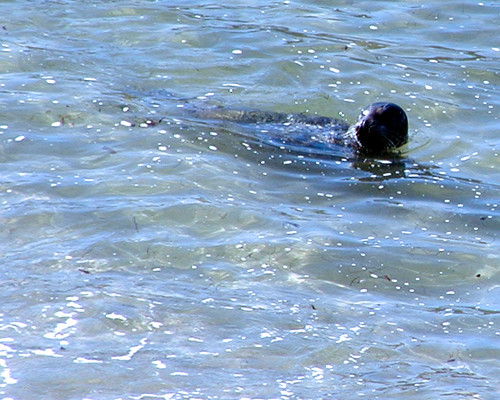
Casa beach is a very tiny beach in the beautiful La Jolla cove area of San Diego. This beach was originally built as a natural "pool" for children to swim in - as a child I swam in it myself. Over time - through the natural processes of the Ocean - the pool was replaced by sand and a beach was formed. In the early 1990s Harbor seals begin to populate the beach in large numbers. Today a Colony of over 200 of these seals rest, and give birth on this tiny beach.
Here is a brief video of the seals at Casa Beach:
Most people enjoy the fact the seals have made Casa Beach their home. But some locals in La Jolla wish to "reclaim" the beach for human beings. Here is the story (via CBS news):
A judge has delayed his order to remove a harbor seal colony from a sheltered beach cove after the governor signed a bill that could let them remain.It seems to me the case is very simple. There are plenty of beaches for people but few for seals. The story of human expansion is the story of animal displacement and extinction. Can't we for once let another species alone? The Beach is public and not private land, it is no longer swimable water for young children as the tides have changed it. For what reason then should people wish to remove the seals? Simply to enforce human dominance? That is a lousy and cruel reason indeed.
Superior Court Judge Yuri Hofmann on Thursday stayed his order just before the deadline expired, pending an October hearing. Earlier this week the judge gave San Diego 72 hours to begin dispersing hundreds of federally protected harbor seals from a beach in La Jolla.
But the city asked the judge to stay his order after Gov. Arnold Schwarzenneger signed a bill permitting the cove to be used as a marine mammal park.
The city has been in a years-long battle over whether the cove known as Children's Pool must be reserved for children.
A seawall was built in 1931 by a local philanthropist, Ellen Browning Scripps, to create a cove where children could safely play in the surf. The Children's Pool (a.k.a. Casa beach) was used for years by kids until harbor seals took over the site in the 1990s.
The seals use the sheltered area to sleep, nurse pups and molt. Though the beach is closed to people, the seawall provides visitors a vantage point for observing seal behavior.
The reason some people want the seals gone is, quite frankly, that they are annoyed by having to share "their" beach with wildlife. The original order to evacuate the seals came from a law suit filed by a swimmer. This swimmer was disturbed because she was fined $100 for swimming too close to the seals. This swimmer - and some wealthy La Jolla residents - have decided to respond to this "inconvenience" by ridding the beach of the seals.
It will be sad indeed of the La Jolla harbor seals are forced to leave. It will be a crime against these seals, a disappointment to the many people who come to admire them in their natural habitat, and another sad tale of human beings forcing other creatures to "get out of our way."
The La Jolla harbor seals have everything to lose and humans nothing to gain, we must support the seals' right to stay at Casa beach. If you are inclined to save the seals: Please sign the following petition:
http://www.rallycongress.com/2/1961/
Wednesday, June 24, 2009
Zakaria's Capitalist Manifesto falls short
I wish to criticize Zakaria on a different point. For Zakaria there is absolutely nothing wrong with the system that brought about our current economic crisis. His argument is that we are just in a bad period and it will soon - in fact already is getting - be all better. After all, Zakaria assures us, every economy has ups and downs and the doomsayers always hail the downs as unprecedented failures, only to be shortly thereafter proved wrong by a boom.
Here are Zakaria's actual words on this matter
Capitalism means growth, but also instability. The system is dynamic and inherently prone to crashes that cause great damage along the way. For about 90 years, we have been trying to regulate the system to stabilize it while still preserving its energy. We are at the start of another set of these efforts. In undertaking them, it is important to keep in mind what exactly went wrong. What we are experiencing is not a crisis of capitalism. It is a crisis of finance, of democracy, of globalization and ultimately of ethics.
"Capitalism messed up," the British tycoon Martin Sorrell wrote recently, "or, to be more precise, capitalists did." Actually, that's not true. Finance screwed up, or to be more precise, financiers did. In June 2007, when the financial crisis began, Coca-Cola, PepsiCo, IBM, Nike, Wal-Mart and Microsoft were all running their companies with strong balance sheets and sensible business models. Major American corporations were highly profitable, and they were spending prudently, holding on to cash to build a cushion for a downturn. For that reason, many of them have been able to weather the storm remarkably well. Finance and anything finance-related—like real estate—is another story.
Finance has a history of messing up, from the Dutch tulip bubble in 1637 to now. The proximate causes of these busts have been varied, but follow a strikingly similar path. In calm times, political stability, economic growth and technological innovation all encourage an atmosphere of easy money and new forms of credit. Cheap credit causes greed, miscalculation and eventually ruin.
There is, of course, some real truth here. But one already sees the problem: Zakaria reminds us that Capitalism is inherently unstable, busts and booms are common. Yes. We all know this. But, he seems to think, we should simply accept this as the inevitable by-product of all that wonderful growth we shall get in the long term.
Zakaria is not wrong about this. But he fails to ask himself and his readers two questions, questions that demand to be asked: 1) is there another system other than pure capitalism that can give us the growth we need, without the frequent busts and recessions? 2) Who profits from the growth? The more deregulated capitalism is, the greater the growth. That's empirically certain. But what Zakaria fails to mention is that fewer and fewer people actually get that growth, leading to a widening gap in which the rich get richer and the poor get poorer. unchecked capitalism leads to wealth and power finding their way into fewer and fewer hands. This also is empirically certain (cf. Paul Krugman The Return of Depression Economics and the Crisis of 2008). Zakaria not only fails to address but fails even to mention these issues.
Of course, on Zakaria's behalf It is only fair to note that he does think a little more regulation is needed. Capitalism should not be totally unrestrained. I grant that the minimal regulations Zakaria - and the Obama Administration - call for are better than nothing. But they are far too little to make a real difference in the long run.
Zakaria - and again the Administration is on the same page - believes that the system of a market dominated by huge multi-national corporations is fundamentally sound. The problems with that system are seen to be the fault of a few greedy companies and individuals who need to be watched a little more closely. If this is done, Zakaria thinks, then everything will just be wonderful.
In Zakaria's own words
There's a need for greater self-regulation not simply on Wall Street but also on Pennsylvania Avenue. We get exercised about the immorality of politicians when they're caught in sex scandals. Meanwhile they triple the national debt, enrich their lobbyist friends and write tax loopholes for specific corporations—all perfectly legal—and we regard this as normal. The revolving door between Washington government offices and lobbying firms is so lucrative and so established that anyone pointing out that it is—at base—institutionalized corruption is seen as baying at the moon. Not everything is written down, and not everything that is legally permissible is ethical.
So the answer for Fareed Zakaria is that we should all be more responsible and more ethical people. Of course we should be. But will a few oversights and a call to conscience really solve the problem? The all too common corruption in the corporate world, the massive amount of exploitation and harm caused by the free market suggest that the problem may be far deeper than a few greedy executives (Cf. The Corporation)
There is ample empirical evidence that the widening gap between the rich and poor, the concentration of wealth into fewer and fewer hands, the exploitation of the working classes the world over, and the buying of our politicians by corporations is the direct result of giving too much freedom and power to the market, whose goal after all is profit (again see Krugman's work and also The Corporation)
Think about it this way: the modern corporation has one goal, to maximize profit. The way to do that is simple: overcharge, scam, cheat, exploit, underpay, rip-off, externalize costs, buy politicians, and otherwise scheme whenever and however you can. One may object to this claim, but on what grounds? If your goal is profit and you are given unimaginable power, very little oversight, and only minor penalties ... well, what do you think will happen? Corruption and deceit are inevitable in system that operates solely for profit, unless that system is very strongly restrained and checked.
Perhaps this evidence can be explained. Perhaps, these charges can be answered. Perhaps a case can be made for capitalism as against other alternatives. Perhaps Zakaria is right to tell us - as he does directly - that capitalism is the best possible system. But he does not discuss any other options. He does not consider the claim that the system itself is irredeemable a serious suggestion.
And this is the core problem with Zakaria's defense of Capitalism: the real possibility that the entire capitalist system - at least corporate capitalism in which multinational corporations run the system - is a serious one, but Zakaria fails to treat it as such.
Sunday, June 21, 2009
Tony Benn and Richard Dawkins debate the value of religion
Thursday, March 26, 2009
Peter Singer on Charlie Rose
For the full 14min interview go here:
Charlie Rose interviews Peter Singer
Singer holds the position that simply refraining from doing what is wrong is insufficient for morality, one must also - and perhaps more importantly - actively do right. Singer, in my opinion, is too extreme about what this asks of us, but I can agree with the heart of the Sentiment.
Monday, January 26, 2009
Embryonic Stell Cell research finallly begins!
This is very good news. Embryonic stem cell research has enormous potential for our most deadly diseases and crippling injuries. Of course some pro-life advocates will regard using such cells as supporting or even committing murder, so it is not without controversy. I respect their concerns and perspective, but being pro-choice, I see the matter differently. I see tremendous hope in this new research:
A note on the ethical issue at stake here: does using Embryonic stem cells in research and/or healing of adult humans, constitute murder? There is no way to answer this question without first doing some metaphysics and asking what a person is, what rights if any non-persons or potential person might have (which in turn requires an analysis of what rights are and how we come to "get" them), and when personhood begins. To be for or against stem cell research is to have a definite position on these matters. And naturally we need to know something about Embryology if we are to know the facts of development.
Subscribe to:
Posts (Atom)